Yaris vs Polo: Supermini Showdown
Toyota Yaris hybrid efficiency battles Volkswagen Polo's dynamic drive in the ultimate small hatch comparison for urban drivers.
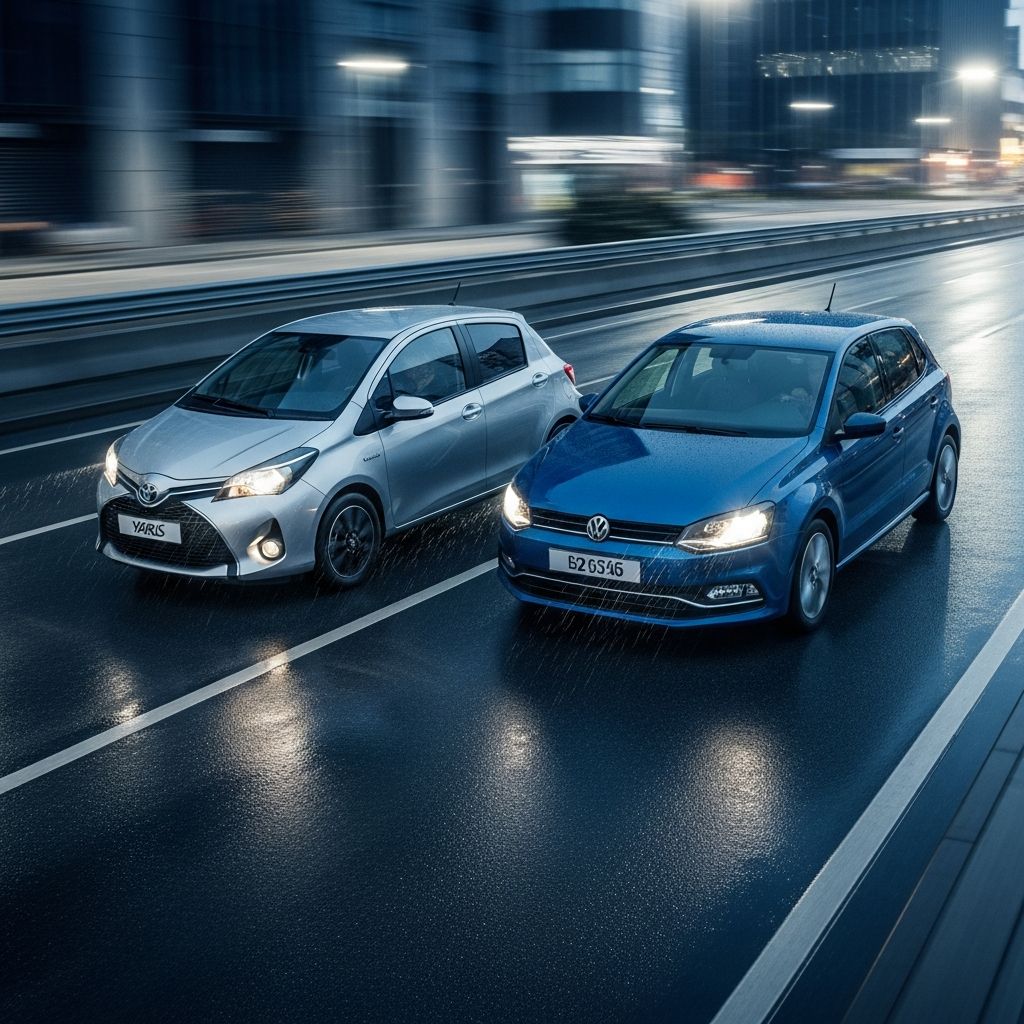
The supermini segment thrives on balancing fun, frugality, and practicality, where the Toyota Yaris hybrid and Volkswagen Polo turbo shine as top contenders. This comparison dives into their powertrains, daily usability, and long-term appeal to help buyers choose wisely.
Powertrain Performance Breakdown
Both cars deliver 85kW of power, but their approaches differ sharply. The Yaris pairs a 1.5-litre three-cylinder petrol engine (67kW/120Nm) with an electric motor (59kW/141Nm), creating a seamless hybrid system for instant low-speed shove. The Polo relies on a punchy 1.0-litre three-cylinder turbo-petrol (85kW/200Nm), peaking torque between 2000-3500rpm for eager mid-range pull.
Acceleration favours the Yaris slightly at 10.4-10.6 seconds to 100km/h, thanks to electric boost off the line, while the Polo’s seven-speed dual-clutch (DSG) transmission shines on open roads but hesitates at starts. The Yaris’s CVT avoids drone in normal driving, though it whines under hard acceleration.
| Spec | Toyota Yaris Hybrid | Volkswagen Polo 85TSI |
|---|---|---|
| Power | 85kW combined | 85kW |
| Torque | 120Nm + 141Nm electric | 200Nm |
| 0-100km/h | 10.4s | 10.6s |
| Transmission | CVT | 7-speed DSG |
Fuel Efficiency and Emissions Edge
Hybrid tech gives the Yaris a clear win in economy, claiming 3.3L/100km combined (as low as 2.8L/100km in city), with a 40L tank enabling up to 1091km range. Real-world figures hold strong, beating the Polo’s 5.4L/100km and 741km range on a 36-40L tank. Lower CO2 at 76g/km (Yaris) vs 123g/km (Polo) appeals to eco-conscious buyers.
The Polo’s turbo efficiency impresses for non-hybrids, but it trails in stop-start traffic where the Yaris’s electric-only mode at low speeds excels.
- Yaris strengths: Unmatched city sipping, EV mode for silent starts.
- Polo strengths: Steady highway cruising without hybrid complexity.
Interior Comfort and Space Realities
Front seating is spacious in both, with supportive seats and intuitive dashboards. The Polo edges rear legroom and shoulder space due to its larger footprint (longer and wider), making it better for families. Yaris rear access feels tighter, with less footroom.
Boot capacity tilts to the Polo at 351 litres (1125L folded) over Yaris’s 270L, though the Yaris tailgate opens higher for easier loading. Materials feel premium in the Polo, while Yaris prioritizes durability.
Driving Dynamics and Ride Quality
Both use MacPherson struts front and torsion beams rear on 15-inch alloys (185/60 tyres for Yaris, 185/65 for Polo). The Yaris absorbs bumps better, feeling plusher on rough roads, but steering is vaguer. Polo offers sharper handling and feedback, though it crashes harder over potholes.
Higher Yaris ground clearance aids uneven streets, while Polo’s lower stance boosts stability. Neither is a track star, but Polo feels more engaging for spirited drives.
Safety Suites Compared
Volkswagen’s IQ.Drive packs AEB (pedestrian/cyclist), lane-keep, fatigue detection, multi-collision brake, rear sensors, reversing camera, and cruise control as standard. Toyota matches with similar tech, including pre-collision braking and adaptive cruise, earning top safety ratings.
Both score highly, but Polo’s rear AEB adds urban confidence.
Tech and Features Face-Off
Yaris includes wireless charging, Apple CarPlay/Android Auto, and drive modes (Eco/Power/EV). Polo counters with digital cockpit, keyless entry, and ambient lighting in higher trims. Base models are well-equipped, with Yaris edging standard kit.
Pricing, Warranty, and Ownership Costs
Drive-away prices start around $32,615 for Yaris Ascent Sport, competitive with Polo Life. Both offer 5-year warranties. Yaris resale holds 70% after five years vs Polo’s 60%, bolstered by hybrid reliability. Servicing favours Toyota’s capped-price plans.
| Aspect | Yaris | Polo |
|---|---|---|
| Fuel Economy (L/100km) | 3.3 | 5.4 |
| Boot Space (L) | 270 | 351 |
| 5-Year Resale | 70% | 60% |
| Warranty | 5 years | 5 years |
Real-World Ownership Verdict
For urban commuters, Yaris hybrid slashes fuel bills and emissions, ideal for short trips. Polo suits longer hauls and families needing space and fun. Reliability tilts Toyota, value long-term too.
Frequently Asked Questions
Which is cheaper to run: Yaris or Polo?
Yaris hybrid at 3.3L/100km crushes Polo’s 5.4L/100km, especially in cities.
Is the Polo more spacious?
Yes, with better rear room and 351L boot vs Yaris’s 270L.
How do they handle safety?
Both excel; Polo adds rear AEB, Yaris strong suite standard.
Performance difference?
Tied at 85kW; Yaris instant torque, Polo mid-range punch.
Best for resale value?
Yaris retains 70% after five years.
References
- Toyota YARIS Vs ALL NEW Volkswagen POLO GTI — YouTube (Car Comparisons Expert). 2023. https://www.youtube.com/watch?v=XxQRzYjxXng
- Toyota Yaris v Volkswagen Polo 2022 Comparison — carsales.com.au. 2022-05-12. https://www.carsales.com.au/editorial/details/toyota-yaris-v-volkswagen-polo-2022-comparison-137587/
- Toyota Yaris v Volkswagen Polo 2022 Comparison — YouTube. 2022. https://www.youtube.com/watch?v=B0_0mMl0bjA
- Toyota Yaris vs Volkswagen Polo — CarsGuide. 2024. https://www.carsguide.com.au/toyota/yaris/vs/volkswagen/polo
- Toyota Yaris vs Volkswagen Polo — CarExpert. 2025. https://www.carexpert.com.au/toyota/yaris/vs/volkswagen/polo
Similar Articles


Read full bio of medha deb