V2X Technology: Transforming Connected Transportation
How vehicle-to-everything communication reshapes modern transportation safety and efficiency
Understanding Vehicle-to-Everything Communication
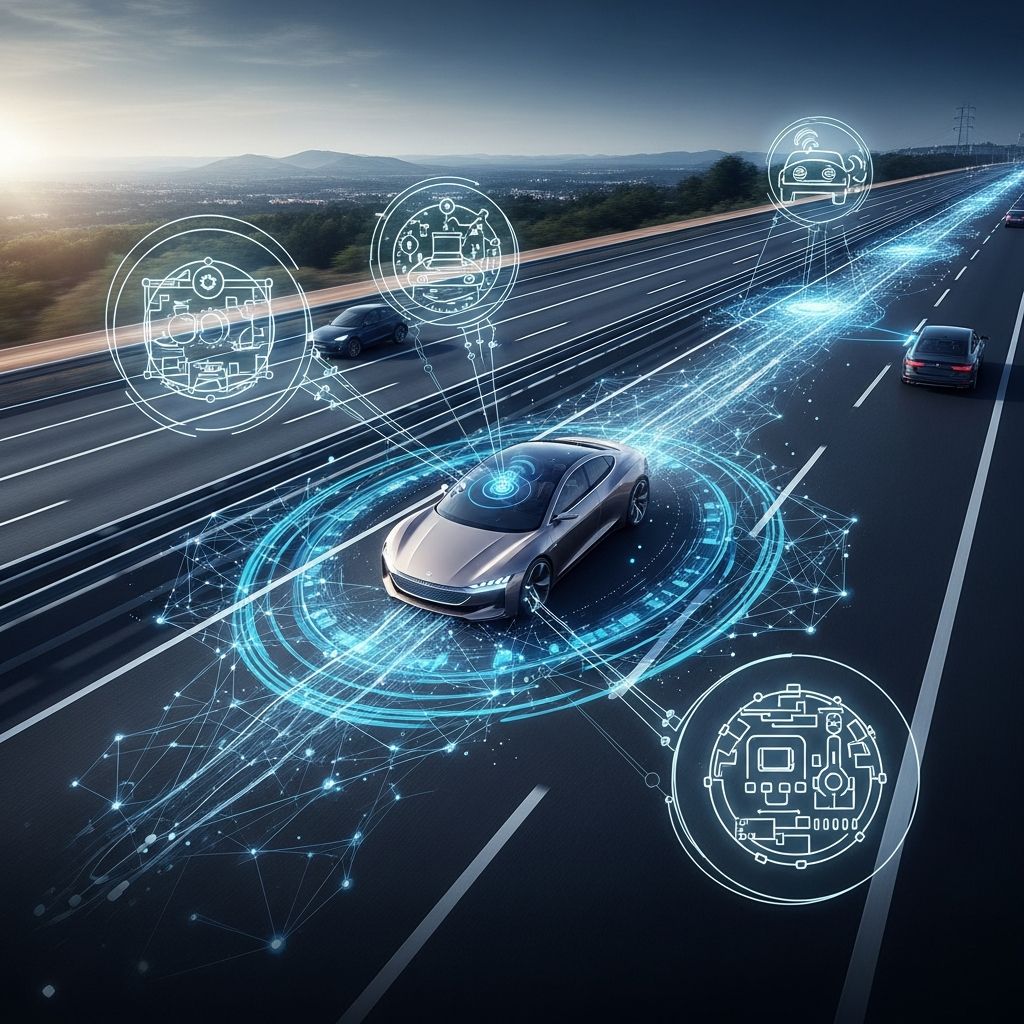
Modern transportation stands at a technological crossroads where vehicles are evolving from isolated machines into interconnected nodes within a larger ecosystem. Vehicle-to-Everything (V2X) technology represents a fundamental shift in how automobiles interact with their surroundings by enabling wireless communication between vehicles and any entity that affects or is affected by them. This comprehensive communication framework encompasses interactions with other vehicles, traffic infrastructure, pedestrians, networks, and stationary devices, creating a dynamic information-sharing environment that transforms road safety and traffic management.
The core principle of V2X operates on the premise that vehicles can send and receive real-time data using wireless protocols such as dedicated short-range communications (DSRC) and cellular-V2X (C-V2X). Unlike traditional vehicle sensors that rely on line-of-sight detection, V2X creates what experts describe as a non-line-of-sight capability that detects objects and hazards without direct visual contact. This technological advancement proves particularly valuable in adverse weather conditions including rain, snow, and low visibility scenarios where conventional sensors struggle to maintain reliability.
The Architecture of Connected Vehicle Systems
V2X technology functions through a sophisticated ecosystem of interconnected components working in concert to deliver actionable intelligence to drivers and autonomous systems. The communication infrastructure relies on standardized message formats that encapsulate critical vehicle and roadway information. Basic safety messages (BSMs) communicate essential vehicle telemetry between automobiles and infrastructure, while signal phase and timing (SPaT) messages describe traffic light states to downstream vehicles.
These communication protocols typically operate within the 5.9 GHz frequency band, which has been reserved internationally for intelligent transportation systems. The selection of this bandwidth enables low-latency, high-reliability exchanges essential for safety-critical applications where milliseconds determine the difference between accident prevention and collision. Edge computing plays a supporting role by processing information at the network perimeter, reducing the requirement for expensive transmission capacity and enabling reflex-like actions such as wrong-way driver detection.
Primary Communication Categories Within V2X
V2X encompasses multiple distinct communication pathways, each serving specific functions within the connected vehicle ecosystem:
- Vehicle-to-Vehicle (V2V): Direct communication between automobiles sharing speed, heading, braking status, and trajectory information to enable cooperative awareness and collision avoidance.
- Vehicle-to-Infrastructure (V2I): Data exchange between vehicles and roadside systems, traffic signals, and smart highway infrastructure that coordinates traffic flow and provides navigational guidance.
- Vehicle-to-Pedestrian (V2P): Wireless alerts between vehicles and pedestrians carrying enabled devices, warning of potential collisions or unsafe crossing conditions.
- Vehicle-to-Network (V2N): Connectivity to cloud-based systems and telematics platforms enabling fleet management, remote diagnostics, and asset tracking.
- Vehicle-to-Device (V2D): Integration with stationary or portable devices including smart city infrastructure and personal electronic devices.
Safety Applications and Collision Prevention
The fundamental motivation driving V2X adoption centers on enhancing road safety through information sharing that prevents accidents before they occur. V2X enables a comprehensive range of safety applications by supplying vehicles with actionable intelligence about imminent threats. Forward collision warnings alert drivers to vehicles braking suddenly ahead, while blind spot warnings identify vehicles in dangerous positions relative to lane changes.
Additional safety features include intersection movement assistance that coordinates vehicle crossing sequences, emergency electric brake light warnings that communicate sudden deceleration to following vehicles, and roadworks alerts that inform drivers of construction zones and hazardous conditions. The technology facilitates platooning operations where vehicles maintain precise spacing and coordinated acceleration, thereby reducing fuel consumption and improving highway efficiency.
Emergency vehicle notifications represent another critical safety dimension, allowing ambulances and fire trucks to communicate their urgent status and request traffic signal priority for faster emergency response times. Prevention of red light running through optimal speed advisory messages helps reduce intersection-related accidents, one of the most common categories of traffic incidents.
Supporting Autonomous and Connected Driving
As the automotive industry progresses toward higher levels of vehicle autonomy, V2X technology becomes increasingly essential for achieving full autonomous driving capability. Autonomous vehicles depend on multiple sensor types including radar, cameras, and lidar to navigate their environment, yet these sensors possess inherent limitations. V2X complements onboard sensors by extending the perception range of autonomous vehicles far beyond what line-of-sight systems can achieve, enabling better decision-making in complex driving environments.
The technology allows autonomous vehicles to process real-time data from their surroundings including traffic flow patterns, road conditions, and potential hazards that may exist beyond the vehicle’s sensor detection range. This expanded awareness enables vehicles to make informed navigational decisions such as rerouting due to congestion, adjusting speeds at intersections based on traffic signal timing, or avoiding potential collisions with hazards detected through V2X communication rather than onboard sensors.
Energy and Efficiency Optimization
Beyond safety and connectivity, V2X technology addresses energy efficiency through intelligent traffic management and vehicle coordination. Energy-efficient intersection control systems use V2X communication to optimize traffic signal timing based on real-time vehicle flow, reducing idle time and unnecessary acceleration events that consume fuel and emit pollutants. When vehicles can coordinate their movement through intersections rather than encountering stop-and-go patterns, fuel consumption decreases substantially across entire traffic networks.
Fleet management represents another efficiency domain where V2N communication enables telematics applications including remote vehicle diagnostics that identify maintenance issues before they cause breakdowns, track and trace of assets for logistics optimization, and communication with central dispatch platforms that route vehicles more efficiently. These applications reduce operating costs while improving service delivery reliability.
V2X and Electric Vehicle Integration
A specialized application of V2X technology involves energy exchange between electric vehicles and external systems. Vehicle-to-Grid (V2G) technology leverages bidirectional charging capabilities that allow electric vehicle batteries to return electricity to utility grids during periods of peak demand or emergency situations. Electric buses and commercial vehicles serve particularly well for V2G applications since they essentially function as mobile battery systems capable of providing capacity, stability, and emergency power to electrical grids.
This integration requires compatible charging protocols such as ChaDeMo, ISO 15118, and OCPP 2.0.1 that enable safe bidirectional energy flow between vehicles and charging infrastructure. As these protocols mature and become more widely supported, additional automakers will adopt V2X charging capabilities, expanding the potential for grid stabilization through the millions of connected vehicles in transportation networks.
Current Implementation and Technology Maturity
While V2X technology demonstrates substantial promise, industry recognition acknowledges that widespread implementation remains in developmental phases. Successful pilot programs have demonstrated V2X functionality in controlled environments and select geographic regions, yet broader market adoption faces several challenges including standardization efforts, regulatory frameworks, and infrastructure deployment requirements.
The technology depends on coordinated deployment of roadside communication equipment, vehicle manufacturer integration of V2X hardware and software, and standardized protocols that enable interoperability between different vehicle brands and infrastructure systems. Regulatory bodies worldwide are developing frameworks that establish V2X deployment requirements and technical standards, though complete harmonization across regions remains incomplete.
Challenges and Future Development Directions
Achieving comprehensive V2X adoption requires addressing infrastructure gaps where rural and less-developed regions may lack the communication systems necessary for V2X functionality. Cybersecurity represents another critical consideration, as wireless communication systems inherently face potential vulnerabilities requiring robust encryption and authentication mechanisms. Privacy concerns arise from the data exchange requirements, as vehicles continuously transmit location and operational information to infrastructure and other systems.
Technology standardization remains an ongoing effort, with different regions potentially adopting different communication protocols that could fragment global markets and reduce efficiency gains. Cost considerations influence adoption rates, as vehicle manufacturers must invest in V2X hardware and software integration while infrastructure operators deploy communication systems across extensive geographic areas.
Broader Implications for Transportation Systems
V2X technology represents a transformative shift in how transportation networks function, moving from systems where individual vehicles make isolated decisions to integrated ecosystems where connected participants share information that optimizes collective outcomes. This transition promises substantial benefits including reduced accident rates through early hazard detection, decreased traffic congestion through intelligent coordination, lower fuel consumption and emissions through optimized driving patterns, and enhanced emergency response capabilities through priority access to transportation networks.
The integration of V2X with emerging technologies including artificial intelligence, 5G networks, and edge computing creates possibilities for increasingly sophisticated transportation management systems. Autonomous vehicles equipped with comprehensive V2X capabilities can operate safely in mixed traffic environments where human-driven vehicles coexist with fully autonomous systems, facilitating gradual market transitions rather than requiring complete fleet transformation before autonomous driving deployment becomes viable.
Frequently Asked Questions About V2X Technology
How does V2X differ from traditional vehicle sensors?
Traditional sensors including radar, cameras, and lidar depend on line-of-sight detection and struggle in adverse weather conditions. V2X provides non-line-of-sight awareness through wireless communication, enabling vehicles to detect hazards and receive information from beyond sensor range, even during rain, snow, or low-visibility conditions.
What communication protocols enable V2X functionality?
V2X operates through dedicated short-range communications (DSRC) and cellular-V2X (C-V2X) protocols that transmit data within the 5.9 GHz frequency band reserved for intelligent transportation systems. These protocols enable low-latency communication essential for safety-critical applications.
How does V2X support autonomous vehicle development?
V2X extends autonomous vehicle perception beyond onboard sensors, enabling access to real-time data about traffic flow, road conditions, and potential hazards from surrounding infrastructure and vehicles. This expanded awareness enables safer decision-making in complex driving environments.
What safety benefits does V2X provide to drivers?
V2X enables forward collision warnings, blind spot alerts, intersection assistance, emergency vehicle notifications, and roadworks warnings that help prevent accidents through early hazard detection and driver alerts.
How might V2X reduce traffic congestion?
V2X enables energy-efficient intersection control that optimizes traffic signal timing, coordinates vehicle movement through congested areas, and provides rerouting information based on real-time traffic conditions, all reducing idle time and improving overall network flow.
References
- V2X Vehicle-to-Everything Communication – The Future of Autonomous Connectivity — Keysight Technologies. 2024-10-03. https://www.keysight.com/blogs/en/inds/auto/2024/10/03/v2x-post
- Vehicle-to-Everything (V2X) — Wikipedia. https://en.wikipedia.org/wiki/Vehicle-to-everything
- What is Vehicle-to-Everything (V2X), Vehicle-to-Everything, technology? — Ptolemy Research. https://www.ptolemus.com/what-is-v2x-vehicle-to-everything-technology/
- Vehicle-to-Everything (V2X): Technology Deep-Dive & Best Practices — FloLive. https://flolive.net/blog/glossary/vehicle-to-everything-v2x-best-practices/
- V2X: Vehicle-to-Everything Solutions — Southwest Research Institute. https://www.swri.org/newsroom/technology-today/v2x-vehicle-everything-solutions
- What is Vehicle-to-Everything (V2X) Technology? — Highland Fleets. https://highlandfleets.com/vehicle-to-everything-v2x-technology/
Similar Articles







Read full bio of medha deb