Tesla Model Y vs Audi Q4 E-Tron: Electric SUV Comparison
Discover which premium electric SUV delivers superior performance, efficiency, and value for modern drivers.
Electric SUV Rivalry: Understanding the Tesla Model Y and Audi Q4 E-Tron
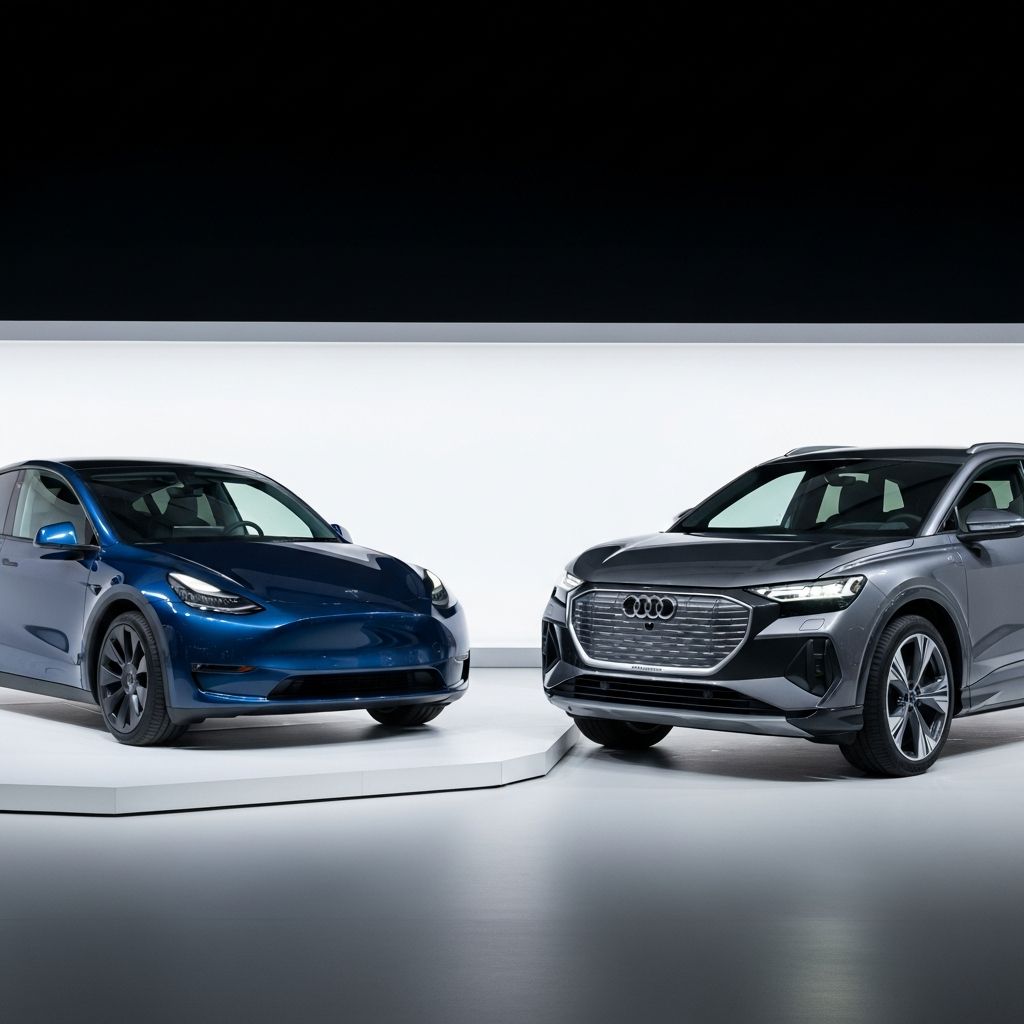
The automotive landscape has undergone a seismic shift toward electrification, and two vehicles have emerged as leading contenders in the premium electric SUV segment: the Tesla Model Y and the Audi Q4 E-Tron. Both represent different philosophies in EV design and manufacturing, yet serve the same fundamental purpose—providing buyers with capable, tech-forward transportation without fossil fuel dependency. Understanding the distinctions between these models is essential for consumers navigating this increasingly competitive market segment.
Pricing and Market Positioning
The financial investment required for each vehicle establishes the foundation of any purchasing decision. The Tesla Model Y enters the market at a significantly lower entry point, with base pricing beginning at approximately $46,380. In contrast, the Audi Q4 E-Tron commands a premium positioning, starting around $51,895. This $5,515 price differential reflects not only the vehicles’ respective brand positioning but also the feature sets and manufacturing philosophies each automaker emphasizes.
Tesla’s strategy focuses on volume production and streamlined manufacturing, while Audi prioritizes luxury appointments and traditional automotive craftsmanship. For budget-conscious buyers seeking EV capability, the Model Y presents an attractive entry threshold. Conversely, consumers willing to invest additional capital for established luxury brand heritage and refined interior treatments find value in the Audi proposition.
Range Performance and Battery Architecture
Range anxiety remains a primary concern for prospective EV buyers, making this comparison particularly significant. The Tesla Model Y demonstrates superior range capabilities across its lineup. The dual-motor Model Y Long Range variant achieves 318 miles of EPA-estimated range, while the performance-oriented Model Y variant delivers 303 miles. These figures represent meaningful real-world capability for extended driving scenarios.
The Audi Q4 E-Tron presents a more modest range proposition. The dual-motor AWD variants of both the standard Q4 and Q4 Sportback models deliver 236 and 242 miles respectively. Audi does offer a single-motor RWD configuration exclusive to the standard Q4 SUV body style, which achieves 265 miles of range. While this configuration approaches the Tesla’s capabilities, it remains unavailable in the Sportback variant.
Both vehicles utilize 82.0-kWh battery packs, yet the Tesla extracts substantially greater range from identical battery capacity. This efficiency advantage stems from Tesla’s superior powertrain engineering, aerodynamic refinement, and overall systems optimization. Buyers prioritizing cross-country capability or those with limited charging access should consider the Model Y’s range superiority as a decisive factor.
Charging Infrastructure and Speed
Charging capability extends beyond simple battery capacity to encompass infrastructure availability and charging velocity. Tesla maintains a formidable competitive advantage through its proprietary Supercharging network, which delivers up to 250-kW charging speeds. Third-generation V3 Superchargers enable rapid battery replenishment, with models capable of adding 238 kilometers of range in merely 15 minutes when utilizing 175-kW infrastructure.
The Audi Q4 E-Tron charges at considerably slower rates, with maximum capabilities limited to 150 kW. While perfectly adequate for overnight home charging scenarios, this disparity becomes pronounced during extended road trips. The recent Q4 E-Tron refresh improved charging efficiency, narrowing the gap somewhat, yet the fundamental speed disadvantage persists.
Home AC charging presents another consideration point. The Model Y accommodates home charging at up to 11 kW, while standard Level 1 and Level 2 charging availability varies by region and installation. Drivers with dedicated home charging infrastructure will find both vehicles manageable for daily charging cycles, but frequent road travelers will appreciate Tesla’s charging speed advantage.
Efficiency Metrics and Operating Economics
Efficiency ratings provide tangible insight into long-term operating costs and environmental impact. The Model Y demonstrates measurably superior efficiency across all driving conditions. The Tesla achieves 134 MPGe in city driving and 117 MPGe on highways, translating to roughly 26-28 kWh per 100 miles in real-world scenarios.
The Audi Q4 E-Tron manages 125 MPGe in urban environments and 104 MPGe during highway driving, requiring approximately 30-32 kWh per 100 miles. While the difference appears modest in percentage terms—roughly 8-10%—it compounds significantly over vehicle ownership duration. A driver traveling 12,000 miles annually will consume approximately 1,200 additional kWh over five years with the Audi compared to the Tesla, representing tangible cost implications and environmental considerations.
This efficiency advantage reinforces Tesla’s overall value proposition, particularly for buyers evaluating total cost of ownership rather than merely initial purchase price.
Performance Characteristics and Driving Dynamics
Modern buyers increasingly expect sporty characteristics even from practical family vehicles. The Tesla Model Y delivers brisk acceleration through its dual-motor architecture, achieving 0-60 mph acceleration in approximately 5.9 seconds for the RWD configuration. Performance-oriented variants descend to under five seconds, providing genuine sports sedan capability.
The Audi Q4 E-Tron’s performance metrics depend upon selected variant. The entry-level 45 model produces 210 kW of power and delivers 545 Nm of torque, enabling 0-100 km/h acceleration in approximately 6.7 seconds. The higher-output 55 variant generates 250 kW of power, with 0-60 acceleration comparable to Tesla’s performance offerings. Recent Q4 E-Tron enhancements increased horsepower by approximately 49 units, narrowing the acceleration gap with the Model Y.
Beyond mere acceleration numbers, driving character differs substantially. The Model Y emphasizes direct, responsive steering and minimal body roll through aggressive suspension tuning. The Q4 E-Tron prioritizes comfort and composure, delivering the refined, composed handling characteristic of traditional Audi engineering. Driver preference will determine which approach proves more satisfying, with Tesla favoring enthusiasts and Audi attracting those valuing luxury ride quality.
Interior Space and Cargo Capacity
Family practicality considerations often influence purchase decisions beyond performance specifications. The Tesla Model Y occupies a considerably larger footprint than its Audi competitor. Measuring 187.0 inches in length with a 113.8-inch wheelbase, the Model Y stretches 6.3 inches longer than Q4 variants and offers 5.1 additional inches of wheelbase. This dimensional advantage translates to tangible interior benefits.
Passenger space advantages favor the Model Y through superior front legroom exceeding half an inch and an impressive 3.3 additional inches of rear legroom. Front and rear headroom measurements also favor Tesla’s packaging efficiency. However, the Audi Q4 E-Tron counters with superior shoulder room for front and rear passengers, providing different space characteristics that suit various body shapes and passenger preferences.
Cargo versatility presents one category where the Audi claims meaningful advantage. The Q4 E-Tron provides 24.8-26.1 cubic feet of cargo space behind the rear seats, with Sportback variants offering slight additional capacity, compared to the Model Y’s 22.4 cubic feet. The Q4’s cargo advantage reflects traditional crossover design priorities, though the Tesla compensates through a front trunk (frunk) providing approximately 28 cubic feet of additional storage—a feature completely absent from the Audi.
Towing capacity further differentiates the vehicles. The Model Y accommodates 3,500 pounds of trailer weight, while the Audi manages approximately 2,600 pounds. For buyers requiring genuine towing capability, the Tesla provides meaningful advantage for boat launching or trailer hauling scenarios.
Interior Design Philosophy and Technology Integration
Cabin experience reflects fundamentally different design philosophies. The Tesla Model Y embraces minimalism through a radically simplified dashboard featuring a centered touchscreen and eliminated traditional instrumentation. This approach yields an undeniably contemporary aesthetic while prioritizing digital interface integration. Climate control, vehicle functions, and entertainment systems concentrate within the touchscreen ecosystem, requiring interface familiarity for optimal operation.
The Audi Q4 E-Tron maintains traditional luxury automotive conventions. Physical controls remain accessible, with redundant digital and mechanical interfaces coexisting. The cabin employs premium materials including soft-touch plastics and available leather appointments, delivering sensory richness characteristic of established luxury marques. Storage solutions throughout the cabin—including clever door panel bottle holders—reflect traditional German engineering attention to detail.
Technology integration favors Audi’s conventional approach for drivers valuing immediate control and tactile feedback. Tesla’s minimalist design appeals to technology enthusiasts embracing touchscreen-centric interaction. Neither approach proves objectively superior; preference depends upon individual expectations regarding cabin experience.
Comparative Performance Overview
| Specification | Tesla Model Y | Audi Q4 E-Tron |
|---|---|---|
| Base Price | $46,380 | $51,895 |
| EPA Range | 303-318 miles | 236-265 miles |
| Maximum Charge Rate | 250 kW | 150 kW |
| City/Highway Efficiency | 134/117 MPGe | 125/104 MPGe |
| 0-60 Acceleration | ~5.9 seconds | ~6.7 seconds |
| Cargo Space | 22.4 cu ft + frunk | 24.8-26.1 cu ft |
| Towing Capacity | 3,500 lbs | 2,600 lbs |
| Battery Capacity | 82.0 kWh | 82.0 kWh |
Frequently Asked Questions
Which vehicle proves more reliable long-term?
Historical reliability data slightly favors the Audi Q4 E-Tron, which benefits from traditional manufacturing processes and established quality control practices. Tesla models occasionally experience build quality inconsistencies and manufacturing defects, though warranty coverage remains comprehensive. Both vehicles represent relatively young product lines with limited long-term reliability histories.
Does the Model Y justify its lower price point?
The Model Y offers superior range, charging speed, efficiency, and towing capability at a lower purchase price. Budget-conscious buyers will find compelling value. Those prioritizing luxury appointments and traditional cabin design may prefer the Audi’s premium positioning despite higher cost.
Which vehicle suits extended road trips better?
The Tesla Model Y excels for cross-country travel through superior range, faster charging speeds, and Tesla’s Supercharger network infrastructure. The Audi suits drivers with primarily local/regional travel patterns who charge at home overnight.
Are both vehicles competitive in performance?
Modern powertrain technology enables both vehicles to deliver responsive acceleration and engaging handling. The Model Y emphasizes dynamic performance, while the Audi prioritizes refined comfort. Both prove more than adequate for typical driving scenarios.
Which interior design proves more user-friendly?
This depends upon individual preferences. Tesla’s minimalist touchscreen-centric approach appeals to technology enthusiasts. Audi’s traditional interface with redundant physical controls suits those valuing immediate tactile control and established automotive conventions.
Making the Purchase Decision
Selecting between these premium electric SUVs requires honest assessment of individual priorities. The Tesla Model Y emerges as the superior choice for buyers prioritizing range capability, charging infrastructure access, total cost of ownership, and driving performance. Its compelling pricing combined with technical superiority across multiple parameters delivers exceptional value within the electric SUV category.
The Audi Q4 E-Tron appeals to consumers valuing luxury brand heritage, refined cabin appointments, and traditional automotive design principles. Buyers with established home charging infrastructure and primarily regional driving patterns will appreciate the Q4 E-Tron’s composed dynamics and premium materials. The vehicle represents an excellent introduction to electric mobility for those accustomed to traditional Audi quality standards.
Both vehicles serve the premium electric SUV market admirably, delivering capability, technology, and environmental benefits. The optimal selection ultimately depends upon balancing technical priorities with personal preferences, budget constraints, and anticipated usage patterns. Prospective buyers are encouraged to experience both vehicles firsthand through test drives, allowing subjective cabin experience and driving dynamics to inform final purchase decisions.
References
- 2023 Tesla Model Y vs. Audi Q4 E-Tron On-Paper Comparison — Motor Trend. 2023. https://www.motortrend.com/news/audi-q4-e-tron-tesla-model-y-specs-comparison
- Audi Q4 e-tron vs. Tesla Model Y — TrueCar. 2024. https://www.truecar.com/compare/audi-q4-e-tron-vs-tesla-model-y/
- Audi Q4 E-Tron vs Tesla Model Y — CarsGuide Australia. 2024. https://www.carsguide.com.au/audi/q4-e-tron/vs/tesla-model-y
- Tesla Model Y vs Audi Q4 e-tron: Electric SUV Showdown — MotorheadMama. YouTube. 2024. https://www.youtube.com/watch?v=Ll4L3r1TCpI
- NEW Tesla Model Y vs Audi Q4 e-tron | WHICH ONE? — Kris Tech. YouTube. 2024. https://www.youtube.com/watch?v=DsEXL6j3dZs
Similar Articles


Read full bio of medha deb