Porsche Carrera GT: The Ultimate Analog Supercar Guide
Discover the raw power and timeless thrill of Porsche's legendary V10 supercar that redefined driving purity.
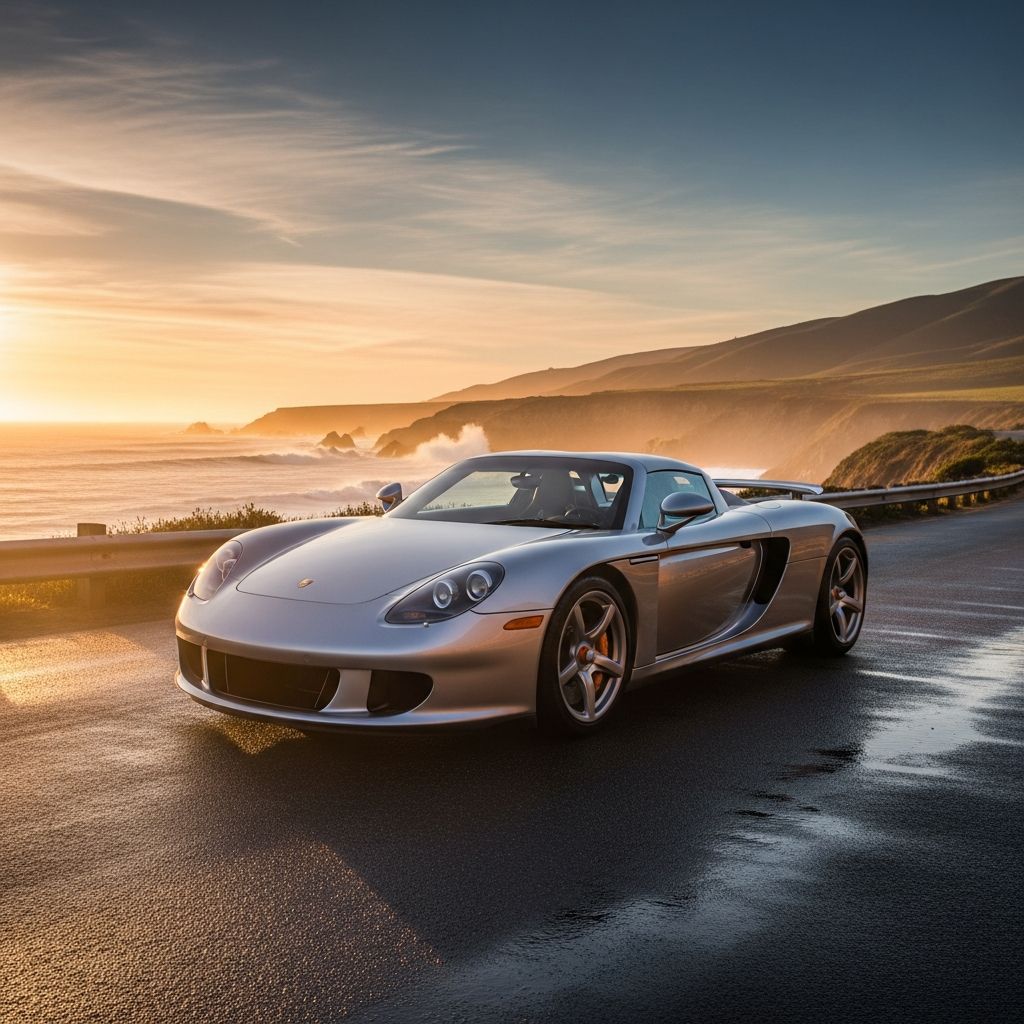
The Porsche Carrera GT stands as a monumental achievement in automotive engineering, a mid-engine roadster that captured the essence of unfiltered driving pleasure during the early 2000s. Produced from 2003 to 2007 in a limited run of just 1,270 units, this supercar was born from Porsche’s racing heritage, evolving directly from the 911 GT1 prototype that dominated Le Mans. With its naturally aspirated 5.7-liter V10 engine delivering 605 horsepower, the Carrera GT offered acceleration that rivaled the era’s elite hypercars while insisting on driver skill through its manual gearbox and absence of electronic aids.
Origins and Development: From Race Track to Road
Porsche unveiled the Carrera GT concept at the 2000 Paris Motor Show, but its roots trace back to the late 1990s when FIA regulations ended GT1 racing. Engineers repurposed the 911 GT1’s V10 powerplant, originally designed for endurance racing, into a street-legal masterpiece. The production model premiered at the 2003 Geneva Motor Show, positioning it as a direct challenger to Ferrari’s Enzo and Mercedes-Benz’s SLR McLaren.
Development emphasized lightweight construction and purity. The carbon-fiber monocoque chassis provided exceptional rigidity without flex, ensuring every road input translated directly to the driver. This race-bred tub, combined with pushrod suspension, allowed the car to handle imperfections with surprising composure, avoiding the bump steer common in wide-tired supercars.
- Racing lineage: Derived from Le Mans-winning 911 GT1 components.
- Limited production: Only 1,270 built, enhancing exclusivity.
- Premiere impact: Debuted amid hype as Porsche’s fastest road car ever.
Powertrain Mastery: The Screaming V10 Heart
At the core lies the 5.7-liter (980/01) naturally aspirated DOHC V10, producing 605 bhp at 8,000 rpm and 435 lb-ft of torque at 5,750 rpm. This engine, a detuned version of the GT1 racer, revved to 8,400 rpm and emitted a symphonic howl that enthusiasts still rave about. Unlike turbocharged rivals, its power delivery was linear and flexible, pulling strongly from low revs—evidenced by a 5-to-60 mph sprint in just 3.7 seconds.
Mated to a six-speed manual transmission with a traditional clutch, the setup demanded precision. No paddle shifters or automatics here; gear changes were deliberate, rewarding skilled drivers. Porsche claimed 0-62 mph in 3.9 seconds, but real-world tests clocked closer to 3.5 seconds, with 100 mph arriving in under 7 seconds and the quarter-mile in 11.2 seconds at 132 mph.
| Performance Metric | Carrera GT | Ferrari Enzo (Comparison) |
|---|---|---|
| 0-60 mph | 3.5 seconds | ~3.4 seconds |
| Quarter-Mile | 11.2 sec @ 132 mph | ~10.9 sec |
| Top Speed | 205+ mph | 217 mph |
| Power | 605 hp | 660 hp |
This table highlights how the Carrera GT matched or exceeded rivals despite its manual transmission, underscoring the engine’s broad torque curve.
Chassis and Handling: Precision Without Safety Nets
The Carrera GT’s dynamics were its defining trait—and its most intimidating. With no electronic stability control or traction control, it relied on mechanical grip from massive Michelin tires: 265/35ZR-19 fronts and 335/30ZR-20 rears. Pushrod suspension delivered zero body roll and immediate turn-in, making it feel alive on grippy surfaces.
Reviewers noted its composure on uneven roads; it absorbed truck ruts and crowned pavement without nervousness. Yet, its sensitivity meant tiny imperfections were felt vividly, with steering so precise you could “drive over a dime and tell the date on it.” High power and rear-wheel drive made it prone to snap oversteer if provoked, earning a reputation as one of the era’s most challenging supercars.
- Steering feel: Ultra-direct, communicative rack-and-pinion.
- Braking: Carbon-ceramic discs for fade-free stopping.
- Balance: Mid-engine layout for neutral handling.
Design and Aerodynamics: Timeless Aggression
Externally, the Carrera GT exuded purposeful menace with its long hood, scissor doors, and massive rear wing. Carbon-fiber bodywork kept weight under 3,040 lbs, aiding agility. The removable carbon roof panel transformed it from coupe to roadster, enhancing the open-air thrill.
Aerodynamics were race-inspired, generating downforce without drag penalties. Air intakes fed the V10 efficiently, while diffusers managed exhaust heat. Its silhouette, evoking the 911 GT1, remains iconic, influencing modern hypercars like the 918 Spyder.
Interior Refinement: Driver-Focused Minimalism
The cabin prioritized function over luxury. A low seating position, perfectly spaced pedals, and a short-throw shifter created an immersive cockpit. Five-analog gauges, with the speedometer canted rightward per Le Mans tradition, flanked a simple console with climate control and optional navigation.
Alcantara and leather trimmed the space, though creature comforts were sparse—no power seats or infotainment overload. Ergonomics shone: the shift lever fell perfectly to hand, pedals encouraged heel-toe downshifts. It felt like a race car adapted for roads, not a diluted grand tourer.
Performance Benchmarks: Track and Road Realities
On the road, the Carrera GT blurred speed limits. From a standstill, it lunged to 60 mph in 3.5 seconds, hit 130 mph in 10.8 seconds, and topped 205 mph. In sixth gear at idle-like 1,200 rpm, it surged from 30-50 mph in 4.3 seconds, showcasing mid-range punch.
Track tests, like Top Gear’s lap, pitted it against the McLaren SLR, with The Stig pushing its limits. Owners praise its drama-free highway poise contrasted with cornering ferocity. Modern tires have tamed some spikiness, but it still demands respect.
Ownership Today: Rarity, Maintenance, and Value
Two decades on, Carrera GTs command premiums, often exceeding $2 million at auction due to scarcity. Maintenance is costly: the V10 requires specialized care, ceramic brakes are pricey to replace, and dry-sump oil systems need vigilant checks. Yet, reliability impresses for a low-volume supercar.
Modern rubber improves usability, mitigating original tire limitations. As batteries and hybrids dominate, its analog purity—manual box, no nannies—cements holy grail status.
Legacy: Influencing Porsche’s Future
The Carrera GT bridged Porsche’s past and future, previewing hybrid tech in the 918 while honoring mechanical purity. It outshone rivals in driver involvement, proving power alone insufficient without engagement. Enthusiasts like Jerry Seinfeld hail it as the “new bench” for supercars.
Today, it embodies a lost era: pre-digital, thrill-focused motoring.
Frequently Asked Questions (FAQs)
What makes the Porsche Carrera GT so special?
Its naturally aspirated V10, manual transmission, and lack of electronic aids deliver unmatched analog driving purity.
How fast is the Carrera GT?
0-60 mph in ~3.5 seconds, quarter-mile in 11.2 seconds, top speed over 205 mph.
Is the Carrera GT street-friendly?
Surprisingly compliant on imperfect roads, but its power and traits demand expert handling.
How many were produced?
1,270 units from 2003-2007.
What’s the maintenance like?
High-cost due to exotic components, but robust for its class.
References
- 2004 Porsche Carrera GT First Drive — Car and Driver. 2004. https://www.caranddriver.com/reviews/a15134212/porsche-carrera-gt-first-drive-review/
- Tested: 2004 Porsche Carrera GT Defines Magnificent — Car and Driver. 2004. https://www.caranddriver.com/reviews/a15132548/porsche-carrera-gt-road-test/
- Porsche Carrera GT – review, history, prices and specs — evo. 2019-12-30. https://www.evo.co.uk/porsche/carrera-gt
- Owner Review: Porsche Carrera GT vs. Ford GT Part 1 of 4 — Ford GT Forum. N/A. https://www.fordgtforum.com/forums/threads/owner-review-porsche-carrera-gt-vs-ford-gt-part-1-of-4.27555/
- Porsche Carrera GT – Ultimate Model Guide — Stuttcars. N/A. https://www.stuttcars.com/porsche-model-research/porsche-supercars/porsche-carrera-gt-research/
Similar Articles


Read full bio of medha deb