Pinzgauer 718 6×6: Ultimate Off-Roader, Specs & Guide
Discover the indestructible Austrian 6x6 beast that conquers any terrain with unmatched capability and military heritage.
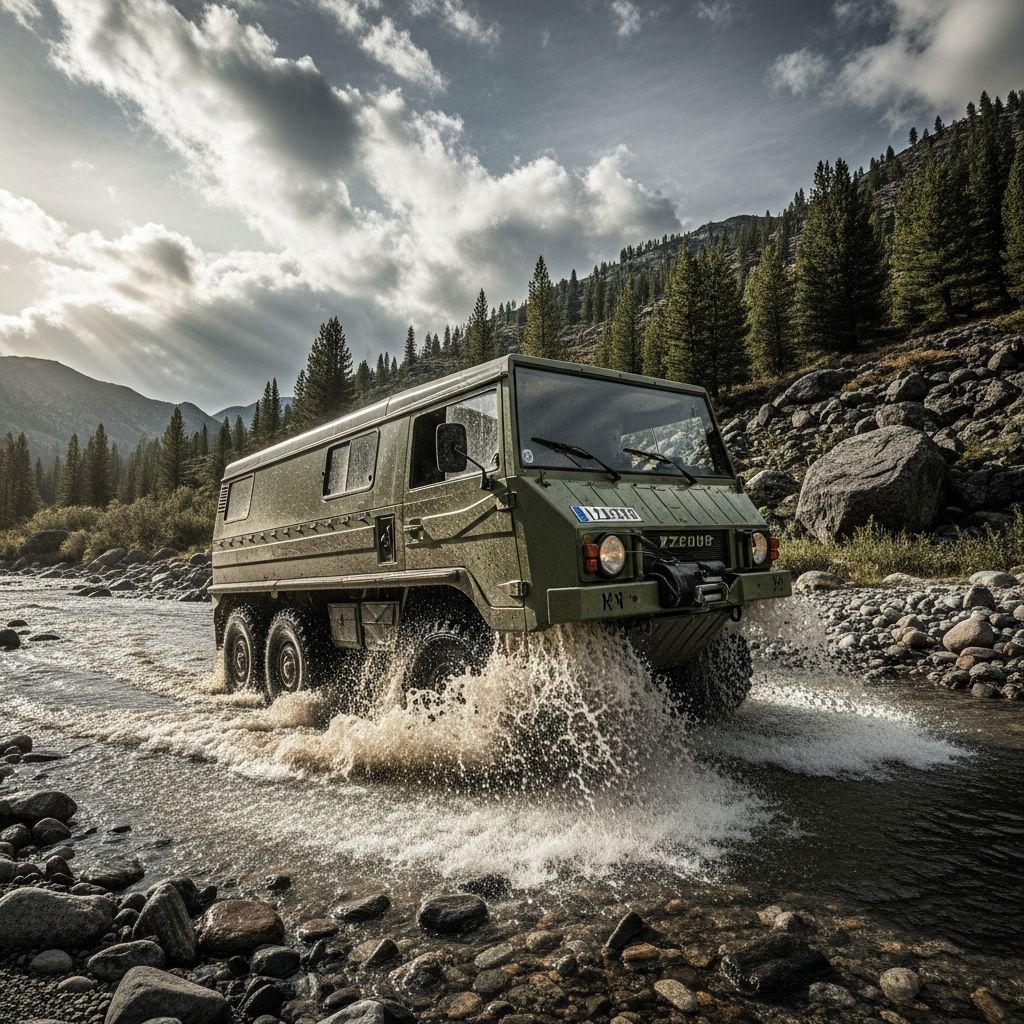
The Steyr-Puch Pinzgauer 718 stands as a monumental achievement in off-road vehicle design, originating from Austria’s rugged alpine regions. Developed for military use, this 6×6 beast combines innovative engineering with raw power to tackle the world’s harshest environments. Its boxy silhouette hides a sophisticated chassis and drivetrain that deliver unparalleled traction and durability.
Origins and Development History
The Pinzgauer lineage traces back to the early 1970s when Steyr-Puch, a renowned Austrian manufacturer, sought to create a high-mobility utility vehicle for armed forces. The Pinzgauer 718 series emerged as the 6×6 variant, building on the success of the 4×4 710 model. Production spanned from 1971 to 2000, with the vehicle proving its worth in militaries worldwide, including Switzerland, Austria, and various export markets.
Designed initially for troop transport and logistics in demanding terrains, the 718K model incorporated a unique central tube chassis that allowed for modular configurations. This innovation enabled easy conversion between 4×4 and 6×6 setups, enhancing its appeal for both military and civilian buyers. By the 1980s and 1990s, updated versions featured more powerful engines compliant with evolving emission standards.
The vehicle’s name derives from the Pinzgau region in Austria, symbolizing its alpine heritage and unyielding spirit. Over decades, surplus military units entered civilian markets, where enthusiasts converted them into expedition rigs, campers, and overland explorers.
Engineering Marvel: Chassis and Suspension
At the core of the Pinzgauer’s dominance is its distinctive cross-tube chassis, a rigid ladder-like frame with independent suspension on all wheels. This setup provides exceptional articulation, allowing wheels to conform to uneven surfaces without compromising stability.
The portal axles elevate the drivetrain above ground level, granting a minimum ground clearance of 335 mm even when fully loaded. Approach and departure angles reach 38° and 45° respectively, enabling navigation over steep obstacles that would ground lesser vehicles. Fording depth stands at 700 mm, making it amphibious in shallow waters.
Suspension employs coil springs and long-travel shocks, ensuring a smooth ride across rocks, sand, or mud. The 6×6 configuration adds two extra driven wheels at the rear, distributing weight for superior flotation on soft ground and climbing ability up to 100% gradients—or until tire grip fails.
Powertrain and Performance Specs
Power comes from Volkswagen-sourced turbo diesel engines, renowned for reliability. Early 1986 models like the 718K Turbo D featured a 2.4-liter inline-6 producing 105 PS (77 kW) and 195 Nm torque with a 5-speed manual, achieving estimated 0-100 km/h in 29.3 seconds. The automatic variant offered 110 PS (81 kW) and 213 Nm, prioritizing ease over outright speed.
| Model Variant | Engine | Power/Torque | Transmission | 0-100 km/h (est.) |
|---|---|---|---|---|
| 718K Turbo D Manual | 2.4L I6 Turbo Diesel | 105 PS / 195 Nm | 5-speed Manual | 29.3 sec |
| 718K Turbo D Auto | 2.4L I6 Turbo Diesel | 110 PS / 213 Nm | 4-speed Auto | 34 sec |
| 2003 UK Spec | 2.5L I5 Turbo Diesel | 136 hp / 280 Nm | 4-speed Auto or 5-Manual | N/A |
Later iterations, such as 2003 UK models, upgraded to a 2.5-liter 5-cylinder intercooled turbo diesel delivering 136 hp at 4,500 rpm and a peak 280 Nm from 1,400-2,400 rpm. This torque-rich setup excels in low-speed crawling, essential for off-road mastery.
On-road performance suits highway runs surprisingly well, with sharp brakes and composed handling despite the high center of gravity. Top speeds hover around 112 km/h, adequate for a 5,000 kg GVM vehicle. Fuel economy remains practical for its class, though exact figures vary by load and terrain.
Off-Road Supremacy in Action
Where the Pinzgauer truly shines is off the beaten path. Selectable 2WD, 4WD, or 6WD at any speed, combined with lockable differentials front, center, and rear, ensures momentum through the toughest conditions. It powers over loose sand, scales slippery inclines, and crawls across rock faces with ease.
- Climbing Ability: 80-100% gradients
- Side Slope: Up to 66% stability
- Traction Control: Portal axles and 6×6 drive prevent wheel spin
- Load Capacity: 5,000 kg GVM for heavy payloads
Dimensions—5,260 mm long, 1,800 mm wide, 2,045-2,160 mm tall—provide ample interior space for six passengers or cargo, while the narrow width aids tight trail navigation.
Interior Comfort and Practicality
Cabin design prioritizes function over luxury, reflecting military roots. Black plastic dashboards host essential gauges, with a truck-like steering wheel offering commanding visibility from the lorry-high perch. Seats accommodate troops or family comfortably, with modular layouts for sleeping or storage.
While austere, modern conversions add insulation, heaters, and amenities for overlanding. Noise levels are manageable thanks to the diesel’s refinement, and the automatic gearbox smooths daily drives.
Dimensions and Capacities Overview
| Specification | Measurement | Notes |
|---|---|---|
| Length | 5,260-5,308 mm | Compact for 6×6 |
| Width | 1,800 mm | Trail-friendly |
| Height | 2,045-2,160 mm | High clearance |
| Ground Clearance | 335 mm | Loaded minimum |
| GVM | 5,000 kg | Heavy-duty |
Civilian Ownership and Modern Relevance
Today, ex-military Pinzgauers attract adventurers seeking bulletproof reliability. UK models from 2003 comply with Euro 3 standards, featuring ZF automatics and synchronized transfer cases. Prices reflect rarity and demand, often exceeding luxury SUVs despite spartan interiors.
Maintenance requires specialist knowledge for the portal axles and transfer case, but parts availability is decent via enthusiast networks. Conversions into ski haulers, party buses, or expedition vehicles extend its life.
Pros and Cons at a Glance
- Pros: Unmatched off-road ability, durable construction, high payload, versatile drivetrain
- Cons: Leisurely acceleration, basic interior, high purchase cost, fuel thirst under load
Frequently Asked Questions (FAQs)
What makes the Pinzgauer 718 different from a Land Rover?
Its 6×6 drive, portal axles, and central tube chassis offer superior articulation and flotation compared to traditional 4x4s.
Is the Pinzgauer street-legal?
Yes, in many countries with modifications; UK 2003 models meet road standards.
How reliable is the engine?
VW turbo diesels are legendary for longevity, often exceeding 500,000 km with proper care.
Can it tow heavy loads?
Absolutely, with enhanced rear suspension in 6×6 models supporting substantial trailers.
What’s the fuel economy like?
Expect 10-15 L/100km combined, better on roads than pure off-roaders.
Why Choose a Pinzgauer in 2026?
In an era of electrified SUVs, the Pinzgauer’s mechanical simplicity and go-anywhere ethos remain timeless. For overlanders, preppers, or off-road purists, it delivers adventure without compromise. Its cult following ensures a vibrant community for support and upgrades.
References
- Steyr-Puch Pinzgauer 718 | Auto Express — Auto Express. 2003. https://www.autoexpress.co.uk/car-reviews/15030/steyr-puch-pinzgauer-718
- 1986 Steyr-Puch Pinzgauer 718 K Turbo D Specs — Automobile-Catalog. N/A. https://www.automobile-catalog.com/car/1986/3170195/steyr-puch_pinzgauer_718_k_turbo_d.html
- 1986 Steyr-Puch Pinzgauer 718 K Turbo D Automatic Specs — Automobile-Catalog. N/A. https://www.automobile-catalog.com/car/1986/3170225/steyr-puch_pinzgauer_718_k_turbo_d_automatic.html
- Steyr Pinzgauer 6×6 — 6-Wheel-Drive.org. N/A. https://www.6-wheel-drive.org/vehicles/pinzgauer-6×6.html
- Steyr-Puch Pinzgauer — Wikipedia. 2023-10-15. https://en.wikipedia.org/wiki/Steyr-Puch_Pinzgauer
Similar Articles




Read full bio of medha deb