Mercedes-Benz SLR McLaren: 4 Iconic Variants And Key Specs
Discover the legendary Mercedes-Benz SLR McLaren, a fusion of F1 heritage and supercar excellence from 2003 to 2010.
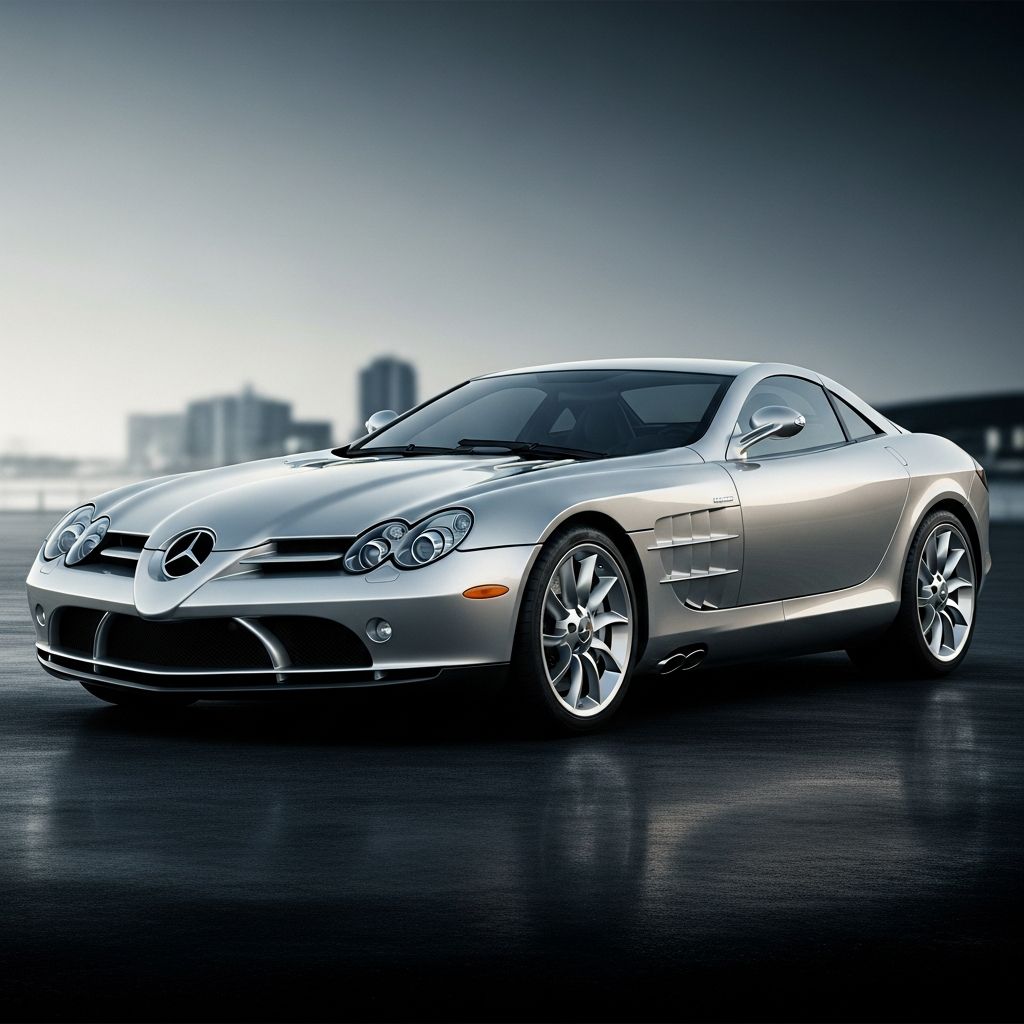
The Mercedes-Benz SLR McLaren stands as a pinnacle of early 2000s supercar engineering, born from a unique partnership between Mercedes-Benz and McLaren Automotive. Launched in 2003, this grand tourer paid homage to the legendary 300 SLR racing car while incorporating cutting-edge Formula 1 technology. With its front-mid-engine layout, carbon-fiber construction, and supercharged V8 power, the SLR delivered blistering performance wrapped in elegant design. Production spanned from 2003 to 2010, with around 2,157 units built, cementing its status as a collector’s dream.
Genesis of a Modern Classic
The SLR’s origins trace back to the 1999 Vision SLR concept, unveiled at the North American International Auto Show. This silver, carbon-fiber prototype featured a 5.0-liter supercharged V8 producing 557 horsepower, hinting at the road-going beast to come. Mercedes enlisted McLaren, their F1 partner, to refine the design for production. Key changes included repositioning the engine nearly a meter rearward for optimal weight distribution, enhancing handling dramatically.
Production began in 2003 at McLaren’s Woking facility in Surrey, UK, and Mercedes’ Portsmouth plant. The name ‘SLR’ derives from ‘Sport Leicht Rennsport’ (Sport Light Racing), echoing the 1950s Mercedes-Benz 300 SLR that dominated races like the Mille Miglia. This collaboration merged Mercedes’ luxury expertise with McLaren’s motorsport prowess, resulting in a car that was both a high-speed cruiser and a track-capable machine.
Revolutionary Engineering Under the Skin
At the heart of the SLR beats a hand-built 5.4-liter (5,439 cc) all-aluminum V8 engine from AMG, augmented by a twin-screw supercharger delivering 0.9 bar of boost. This M155 powerplant churns out 617 horsepower at 6,500 rpm and 575-580 lb-ft (780 Nm) of torque from 3,250 to 5,000 rpm. The front-mid-engine placement—behind the front axle—combined with a carbon-fiber monocoque tub bonded to an aluminum subframe, optimized balance for superior dynamics.
Power flows through a five-speed AMG Speedshift automatic transmission with paddle-shift manual modes to the rear wheels. Early models hit 0-60 mph in 3.6-3.8 seconds, with quarter-mile times around 11.2 seconds at 130 mph. Top speed reached 207-208 mph, limited electronically. Braking came courtesy of pioneering carbon-ceramic discs—Mercedes’ first production use—resistant to fade up to 2,200°F, paired with eight-piston front calipers.
| Component | Specification |
|---|---|
| Engine | 5.4L supercharged V8, 617 hp, 580 lb-ft |
| Transmission | 5-speed auto with manual modes |
| 0-60 mph | 3.6 seconds |
| Top Speed | 208 mph |
| Weight | ~3,950 lbs (1,792 kg) |
| Brakes | Carbon-ceramic discs |
Suspension featured adaptive damping, with the rear axle rising 40 mm under hard braking to maintain stability. Aerodynamics shone through a deployable rear spoiler acting as an airbrake, generating downforce while aiding high-speed stability. The SLR’s exhaust note, blending V8 rumble with supercharger whine, remains one of its most distinctive traits.
Design: F1 Flair Meets Grand Touring Elegance
Styling drew heavily from Mercedes’ racing heritage, with a long hood, plunging nose bearing the three-pointed star, and wide stance evoking Silver Arrows. Carbon-fiber panels clad the body, keeping weight in check despite the grand tourer dimensions: 185 inches long, 77 inches wide. Interiors boasted premium leather, aluminum trim, and McLaren-engineered seats with carbon backs for support during high-g cornering.
Side vents aided engine cooling, while tinted red rear lights and a rotary door mechanism added drama. The cabin prioritized driver focus, with navigation, Bose audio, and climate control, though some critics noted the automatic-only gearbox felt dated against rivals’ dual-clutches.
Performance Variants: Pushing the Boundaries
- SLR 722 Edition (2006): Named after Stirling Moss’s 1955 Mille Miglia-winning number, this upgrade boosted output to 641 hp and 604 lb-ft via revised supercharger, cams, and exhaust. It shaved 0-60 to 3.6 seconds, top speed to 209 mph. Limited to 150 coupes, it featured stiffer suspension, larger carbon-ceramic brakes, and unique styling like a carbon-fiber front splitter.
- SLR 722 S Roadster (2007): A convertible take on the 722, with 650 hp and 605 lb-ft. Only 150 built, it matched coupe acceleration with a 208 mph top speed, power top stowed neatly.
- SLR McLaren Stirling Moss (2009): The ultimate speedster: roofless, windowless, limited to 75 units for existing SLR owners. Same 650 hp V8 propelled it to 0-60 in under 3.5 seconds and 217 mph. Ultralight at 2,866 lbs, it demanded skill at speed.
- SLR 722 GT (2008): Track-focused by RML, shedding 400 kg to 1,300 kg via aero tweaks, stripped interior, and reinforced chassis. 670 hp enabled 0-62 mph in 3.3 seconds; 21 built for club racing.
Driving Dynamics and Real-World Thrills
Behind the wheel, the SLR balanced supercar ferocity with GT usability. Its 50:50 weight distribution and McLaren-tuned chassis delivered planted cornering, though the 3,950-lb curb weight showed in tight turns. Car and Driver praised top-gear passing: 30-50 mph in 1.7 seconds, 50-70 in 2.4—record-setting for production cars then. On track, carbon brakes and grip levels impressed, but tire wear was high.
Owners lauded the instant torque surge post-3,000 rpm, supercharger whine building to a symphonic howl. Highway cruising was effortless, with wind noise low despite the profile. Fuel economy hovered at 11-15 mpg, typical for the era’s power.
Legacy and Collectibility Today
Though overshadowed by rivals like the Bugatti Veyron or Ferrari Enzo in outright speed, the SLR’s blend of heritage, tech, and rarity endures. Values have climbed: standard models fetch $250,000-$400,000, rarities like Stirling Moss exceeding $3 million at auction. Reliability issues like carbon top failures and supercharger whine persist, but McLaren’s service network helps.
Mercedes and McLaren’s tie-up influenced future projects like the P1 hypercar. The SLR remains a bridge between road and race, proving grand tourers could thrill without sacrificing comfort.
Common Specs Comparison
| Model | Horsepower | 0-60 mph | Top Speed | Production |
|---|---|---|---|---|
| Standard SLR | 617 hp | 3.6s | 208 mph | ~2,000 |
| 722 Edition | 641 hp | 3.6s | 209 mph | 150 |
| Stirling Moss | 650 hp | <3.5s | 217 mph | 75 |
| 722 GT | 670 hp | 3.3s (0-62) | N/A | 21 |
Frequently Asked Questions
What makes the SLR McLaren special?
Its F1-derived carbon chassis, supercharged AMG V8, and Mercedes-McLaren partnership set it apart as a tech showcase.
How reliable is the SLR today?
Common issues include supercharger bearings and carbon roof delamination, but specialist maintenance keeps them running strong.
What’s the rarest SLR variant?
The Stirling Moss speedster, with just 75 units, is the holy grail for collectors.
Can the SLR handle track days?
Yes, especially the 722 GT, but standard models excel more as GTs than pure track cars.
Why was production limited?
Hand-built exclusivity and high costs targeted ultra-wealthy buyers, ending in 2010.
References
- Mercedes-Benz SLR McLaren Model Year History — J.D. Power. N/A. https://www.jdpower.com/cars/history/mercedes-benz/slr-mclaren
- The Mercedes-Benz SLR McLaren Doesn’t Get the Respect It… — MotorTrend. N/A. https://www.motortrend.com/features/mercedes-benz-slr-mclaren-supercar-history-retrospective
- McLaren-Mercedes SLR model guide — Prestige & Performance Car. N/A. https://prestigeandperformancecar.com/mercedes/mclaren-mercedes-slr-model-guide/
- 2006 Mercedes-Benz SLR McLaren — Audrain Auto Museum. N/A. https://www.audrainautomuseum.org/grand-touring-cars-through-the-decade/2006-mercedes-benz-slr-mclaren
- History of the Mercedes-Benz SLR McLaren — GTspirit. 2012-05-15. https://gtspirit.com/2012/05/15/history-of-the-mercedes-benz-slr-mclaren/
- Mercedes-Benz SLR McLaren — Wikipedia. N/A. https://en.wikipedia.org/wiki/Mercedes-Benz_SLR_McLaren
Similar Articles


Read full bio of medha deb