The Lancia Delta Integrale: Rally’s Greatest Champion
How an Italian compact car revolutionized motorsport and dominated World Rally Championships for six consecutive years.
From Practical Family Car to Motorsport Legend
The story of the Lancia Delta Integrale represents one of the most remarkable transformations in automotive history. What began as a practical, everyday compact hatchback designed by legendary stylist Giorgetto Giugiaro in 1979 would eventually become the most dominant force in rally racing the sport had ever witnessed. The original Delta was revolutionary for its time—elegant, functional, and spacious—earning the prestigious Car of the Year award from European specialist press in 1980. However, few could have predicted that this unassuming family vehicle would eventually rewrite the record books and establish performance standards that would influence decades of automotive engineering.
The path from ordinary hatchback to championship-winning rally machine was neither accidental nor instantaneous. It required vision, engineering expertise, and a willingness to experiment with technologies that were considered cutting-edge during the mid-1980s. Lancia recognized early that beneath the Delta’s practical exterior lay untapped potential for performance development. By the mid-1980s, the company began a series of evolutionary steps that would transform this modest platform into an unstoppable competitive force.
The Genesis of Four-Wheel Drive Performance
The first critical turning point came in May 1986 when Lancia introduced the Delta HF 4WD, a pivotal moment that marked the beginning of the car’s rally career. This model incorporated four-wheel drive technology and a turbocharged engine, creating an entirely different driving experience despite maintaining the Delta’s familiar appearance. The 4WD system paired with the 2-liter, 8-valve turbocharged engine produced 165 horsepower in standard form and 150 horsepower in its emissions-regulated green version, delivering previously unachievable performance characteristics for a car of its size and category.
The engineering solution for the 4WD system demonstrated Lancia’s practical approach to innovation. Rather than developing entirely new components from scratch, engineers adapted existing technology already in production across the Lancia lineup. The transmission system came from the Prisma 4WD, which shared a common platform with the Delta, while the engine utilized the proven powerplant from the Thema Turbo. The critical enhancement involved retrofitting a sportier Torsen differential in the rear, which significantly improved traction and handling dynamics compared to conventional limited-slip designs of the era.
Visual and Performance Evolution
By 1987, Lancia unveiled the Delta HF Integrale, representing the first major evolution of the four-wheel drive concept. This version incorporated substantial technical refinements that elevated performance to new heights. The new engine variant displaced 1,995 cubic centimeters and featured a significantly enlarged Garrett T3 turbocharger that permitted greater air flow into the combustion chambers, resulting in markedly improved power delivery and acceleration characteristics. These modifications produced impressive performance figures: a maximum speed of 220 km/h, acceleration from 0 to 100 km/h in 5.7 seconds, and the ability to complete a kilometer from a standing start in 26.1 seconds.
To address emerging environmental regulations without compromising performance, Lancia simultaneously introduced the Delta Integrale HF Kat, an 8-valve variant equipped with a catalytic converter designed to meet anti-pollution requirements while maintaining drivability. This demonstrated Lancia’s commitment to environmental responsibility alongside competitive excellence—a balance few manufacturers successfully achieved during this period.
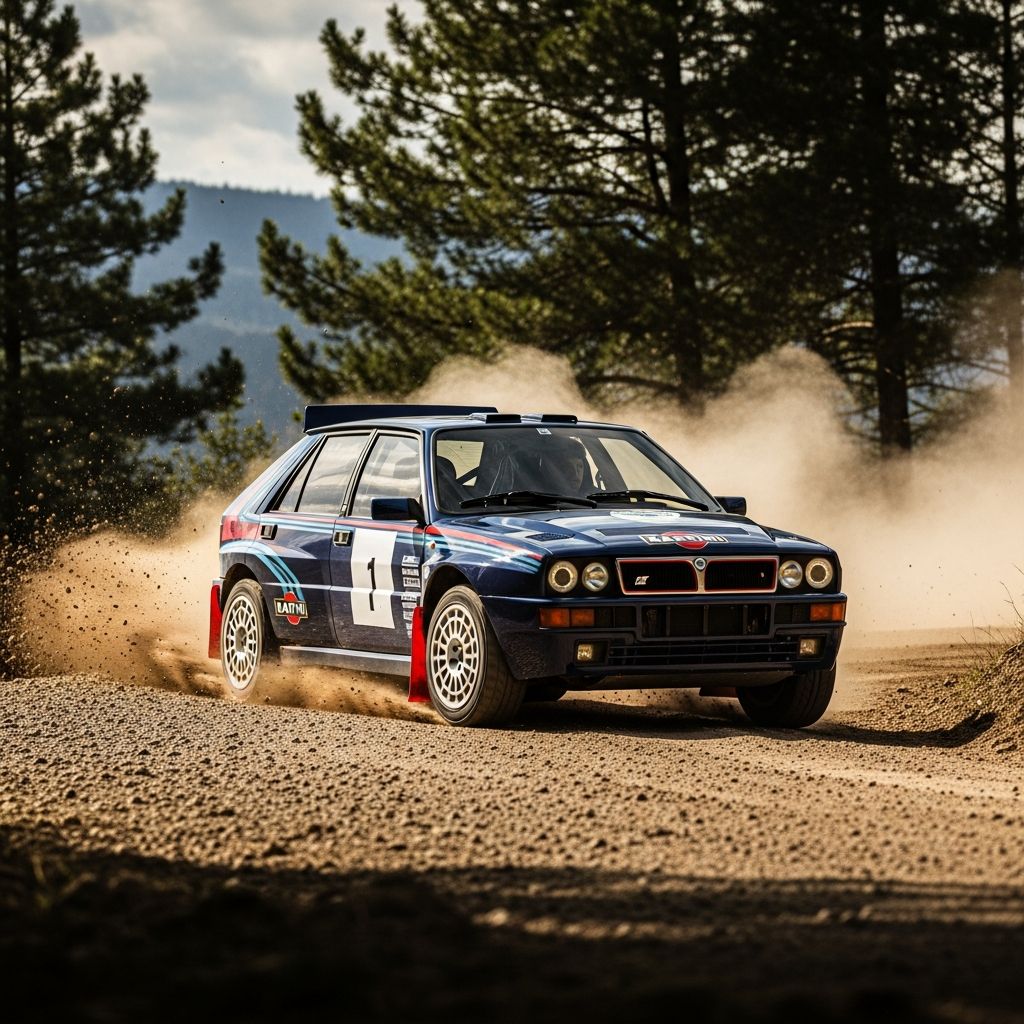
The exterior design evolved to accommodate improved mechanical capabilities. The iconic blistered wheel arches made their debut on the Integrale platform, a styling element that became visually synonymous with the model. These pronounced fenders were not merely aesthetic—they housed wider wheels, larger tires, and enhanced suspension geometry necessary for the vehicle’s increased performance envelope and improved traction characteristics.
Rally Dominance and Competitive Success
The 1987 rally season proved transformative for Lancia. The Delta HF 4WD won nine of thirteen championship rounds while securing both the drivers’ and constructors’ titles—an extraordinary achievement that established the platform as a genuine competitive threat in the World Rally Championship. This success was not merely a fortunate outcome but rather the result of intelligent engineering, driver skill, and a team that understood how to maximize the vehicle’s potential across diverse rally environments.
As competitors began developing their own four-wheel drive rally cars, Lancia responded strategically by introducing the Integrale 16V in 1989, which featured a sophisticated 16-valve engine producing 182 horsepower and 224 foot-pounds of torque. The enlarged Garrett turbocharger, coupled with 16-valve combustion chamber technology, delivered superior power characteristics while maintaining reliability over the demanding rally season. Revised suspension geometry, larger wheels and brakes, and enhanced damping systems refined the handling package, keeping the Integrale competitive even as rival manufacturers invested heavily in their own programs.
Between 1987 and 1992, the Lancia Delta Integrale secured six consecutive World Rally Championship constructors’ titles, establishing a record unmatched by any other automobile in the history of motorsport. This extraordinary achievement reflected not only exceptional vehicle engineering but also Lancia’s ability to attract world-class drivers and maintain consistency across multiple seasons during an era when rival manufacturers were rapidly advancing their own technologies.
The Ultimate Evolution: Integrale Evoluzione Models
By October 1991, facing increased competition and anticipating stricter regulations, Lancia introduced the Integrale Evoluzione, sometimes referred to informally as the Deltona. This represented a comprehensive re-engineering effort that addressed technical and structural limitations of previous iterations. The body received significant widening to accommodate wider track geometry, while the front suspension employed revised attachment points and extended travel distances to improve compliance over rough terrain typical of European rally stages.
The Evoluzione incorporated multiple detail refinements that collectively enhanced reliability and performance consistency. Additional air intakes improved engine breathing and cooling efficiency, while larger front brakes—featuring four-piston aluminum calipers—provided stopping power appropriate to the vehicle’s improved acceleration capabilities. A dedicated cooling circuit for power steering fluid prevented thermal degradation during extended high-intensity driving, a practical engineering solution often overlooked but essential for consistent performance.
The Evoluzione II, introduced in June 1993, represented the final and most sophisticated iteration. Featuring a 2.0-liter turbocharged 16-valve engine producing 215 horsepower, this variant incorporated advanced engine management systems developed by Magneti-Marelli, featuring 8MHz processor speed with doubled memory capacity compared to earlier electronic control units. A double ignition coil with dual outputs provided enhanced combustion consistency, while an advanced knock sensor enabled adaptive fuel mapping to accommodate fuel quality variations common across different rally venues. Sixteen-inch wheels completed a package that demonstrated how incremental refinement across multiple systems could maintain competitiveness even as the technology landscape shifted around Lancia’s platform.
Production and Market Reality
Despite its overwhelming rally success, the Lancia Delta Integrale remained a specialized product with limited production volume relative to mainstream automobiles. Approximately 25,000 units were manufactured across all iterations, with the Evoluzione family restricted to roughly 13,500 vehicles as Lancia emphasized exclusivity and desirability. Exclusive special series produced through 1995 became increasingly sought by enthusiasts, as the company recognized that the Integrale represented a defining moment in its corporate history.
The financial reality of rally motorsport meant that only committed manufacturers with substantial resources could sustain competitive programs at the highest levels. Lancia’s six-year championship dominance required continuous investment in development, testing, and competitive operations—expenditures that eventually became unsustainable as the automotive industry consolidated and corporate priorities shifted toward volume production and market share rather than motorsport prestige.
Legendary Drivers and Competitive Legacy
The Integrale’s success attracted elite drivers from across the international rally community. Hannu Mikkola, Ari Vatanen, Michele Mouton, Markku Alen, and eventually Carlos Sainz all secured championship victories driving Lancia vehicles, establishing a roster of talent that reflected the platform’s credibility as a winning machine. The combination of superior vehicle engineering and exceptional driving talent created a competitive equation that competitors struggled to replicate despite significant resources and effort.
Influence on Modern Performance Vehicles
While the Lancia Delta Integrale ceased competitive production by the mid-1990s, its influence extended far beyond its retirement from active service. The vehicle established technological and performance templates that influenced subsequent generations of performance automobiles. Modern all-wheel drive systems, turbocharging technologies, and rally-derived suspension architectures owe conceptual debts to the engineering solutions Lancia pioneered during the Integrale’s development. Subsequent performance vehicles from manufacturers worldwide incorporated lessons learned from analyzing the Integrale’s capabilities and competitive successes.
The Integrale demonstrated that a practical, accessible platform could be transformed into an elite competitive machine through intelligent engineering, quality manufacturing, and meticulous attention to performance details. This principle influenced how manufacturers subsequently approached performance model development—recognizing that specialized variants could share common platforms while achieving dramatically different capabilities through targeted technical investment.
Enduring Historical Significance
The Lancia Delta Integrale transcends its role as merely a competition automobile. It represents a defining moment when a European manufacturer achieved sustained excellence through technical innovation, competitive dedication, and unwavering commitment to performance. The vehicle’s record—six consecutive World Rally Championship titles between 1987 and 1992—remains unmatched by any competitor in rally racing history. This achievement establishes the Integrale as the sport’s greatest single platform, a distinction that contemporary manufacturers acknowledge even as they pursue their own competitive programs.
Today, surviving examples of the Lancia Delta Integrale command respect from automotive enthusiasts, collectors, and historians who recognize its historical importance. The vehicle represents a unique convergence of practical everyday transportation and elite motorsport competition—a duality rarely achieved in automotive history. As the foundation for modern rally car development and as a symbol of Italian engineering excellence during a particularly innovative period, the Lancia Delta Integrale deserves recognition as one of the most significant automobiles ever produced.
References
- History – Lancia Delta Integrale Club — Lancia Delta Integrale Club. Accessed 2026. https://www.lanciadeltaintegraleclub.net/xEng/StoriaIntegrale.shtm
- Lancia Delta Integrale (1987 – 1994) – History, Review and Specs — EVO Magazine. Accessed 2026. https://www.evo.co.uk/lancia/delta/integrale
- The History of the Lancia Delta Integrale — Benecar. Accessed 2026. https://benecar.pt/en/news/the-history-of-the-lancia-delta-integrale
- Lancia Delta HF 4WD/Integrale — Stellantis Heritage. Accessed 2026. https://www.stellantisheritage.com/en-uk/heritage/stories/lancia-delta-HF-4WD-integrale
- History – Karlhofer Delta Historic GmbH — Delta Historic GmbH. Accessed 2026. https://www.delta-historic.com/en/history/
- Lancia Delta Integrale – History and Technical Infos — Rally Cars. Accessed 2026. https://rallycars.com/cars/lancia-delta-integrale-car/history/
- Lancia Delta Integrale Evo — World Rally Championship. Accessed 2026. https://www.wrc.com/en/misc/lancia-delta-integrale-evo
Similar Articles





Read full bio of medha deb