Golf Estate vs Corolla Touring: Estate Showdown
Discover which family estate excels in space, efficiency, and driving fun: VW Golf Estate or Toyota Corolla Touring Sports?
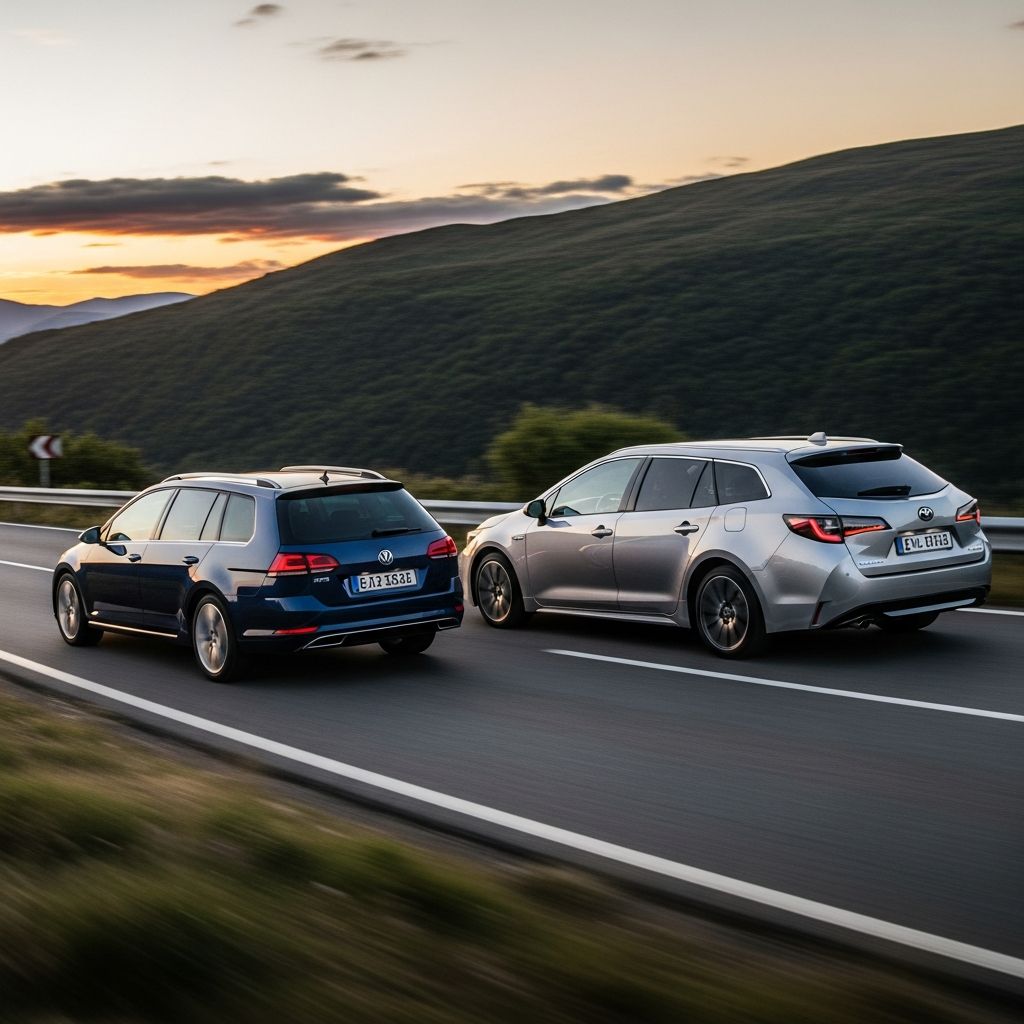
The Volkswagen Golf Estate and Toyota Corolla Touring Sports represent two strong contenders in the family estate car segment, blending practicality with modern efficiency. This comparison evaluates their key strengths across performance, space, running costs, and everyday usability to determine the ideal choice for buyers seeking versatile wagons.
Powertrain Options and Driving Performance
Both vehicles prioritize efficiency but approach it differently. The Golf Estate in Style 2.0 TDI 150PS DSG trim features a 2.0-litre turbodiesel engine producing 148bhp and 360Nm of torque, paired with a seven-speed DSG automatic gearbox. This setup delivers brisk acceleration, hitting 0-62mph in 8.8 seconds, making it punchier than many rivals.
In contrast, the Corolla Touring Sports 1.8 Hybrid Excel relies on a 1.8-litre petrol-electric hybrid system totaling 120bhp. Its continuously variable transmission (CVT) results in a more leisurely 0-62mph time of 11.1 seconds. While the Golf feels more engaging on open roads thanks to its responsive DSG, the Toyota shines in urban settings where its electric motor provides seamless, quiet propulsion.
| Specification | VW Golf Estate 2.0 TDI | Toyota Corolla 1.8 Hybrid |
|---|---|---|
| Power | 148bhp | 120bhp |
| Torque | 360Nm | 142Nm (system) |
| 0-62mph | 8.8s | 11.1s |
| Transmission | 7-speed DSG | CVT |
On motorways, the diesel Golf’s torque advantage makes overtaking effortless. However, the hybrid Corolla’s CVT can hold revs high during acceleration, though cabin insulation keeps noise low. In city traffic, the Toyota’s EV mode offers superior refinement, avoiding the Golf’s occasional DSG hesitation.
Interior Comfort and Rear Passenger Space
Both estates accommodate families comfortably, but subtle differences emerge. The Golf Estate’s higher roofline creates an airier cabin, with ample legroom and headroom for rear adults. The centre rear seat is narrow in both, typical for this class, but shoulder room feels generous in the VW.
The Corolla provides similar rear space, though its slightly lower roof makes it feel less expansive. Front seats in both are supportive, with the Golf offering more adjustability in higher trims. Material quality is premium in the VW, featuring soft-touch surfaces, while the Toyota opts for durable, hard-wearing plastics suited to high-mileage use.
- Golf Estate advantages: Taller cabin, better seat ergonomics.
- Corolla strengths: Quieter at low speeds, intuitive controls.
Boot Capacity and Practical Features
Load-lugging defines estate cars, and the Golf Estate leads with 611 litres of boot space (seats up), surpassing the Corolla’s 581 litres. Folding the rear seats expands this to over 1,600 litres in both, but the VW’s squarer shape eases loading bulky items.
Towing sets them apart: the Golf’s diesel hauls 1,600kg braked, ideal for trailers or caravans, while the Corolla manages just 750kg due to its hybrid setup. Both include practical touches like remote tailgate operation and 60/40 split-folds.

Family haulers benefit from the Golf’s edge in versatility, especially for those needing towing capability.
Fuel Efficiency and Real-World Economy
Test results highlight the Golf’s diesel prowess at 62.3mpg overall, translating to £1,086 annual fuel costs over 12,000 miles. The Corolla achieved 48.8mpg (£1,386/year), though its hybrid system excels in stop-start conditions, potentially closing the gap in urban driving.
CO2 emissions favor the Toyota at 103g/km versus the Golf’s 124g/km, impacting company car taxes: £1,490/year (25% BiK) for the Corolla versus £1,633 (27% BiK) for the VW (standard-rate taxpayer).
Recent EPA data on similar models shows the Corolla hatch edging the Golf in US combined figures (around 36mpg vs 34mpg), but estate variants prioritize load over pure efficiency.
Safety Systems and Driver Assistance
Safety is uncompromising, with both securing five-star Euro NCAP ratings. Standard kit includes autonomous emergency braking (AEB), adaptive cruise control, lane-keep assist, and auto high beams.
The Golf adds blind-spot monitoring in some packs, while Toyota’s Safety Sense suite emphasizes pre-collision alerts. Real-world reliability bolsters the Corolla’s reputation, though VW’s tech feels more integrated.
Technology and Infotainment
Digital cockpits dominate: the Golf’s 10.25-inch Virtual Cockpit pairs with a 8-inch touchscreen, supporting wireless Apple CarPlay/Android Auto. The Corolla’s 10.5-inch display is sharp, with hybrid-specific readouts, but wired connectivity lags.
- Audio: Both have eight-speaker systems; Golf offers premium upgrades.
- Navigation: Built-in on higher Golf trims; Toyota relies on smartphone mirroring.
Ownership Costs and Residual Values
Starting prices are close: £30,465 for the Golf, £30,010 for the Corolla (as tested up to £36,670 with options). After three years/36,000 miles, residuals are £13,950 (45.8%) for VW and £14,414 (48.0%) for Toyota, giving the hybrid a slight edge.
| Cost Factor | Golf Estate | Corolla Touring |
|---|---|---|
| Price (base) | £30,465 | £30,010 |
| 3yr Residual (%) | 45.8% | 48.0% |
| Annual BiK (std rate) | £1,633 | £1,490 |
| Road Tax | £150 | £140 |
Maintenance favors Toyota’s bulletproof hybrid, but VW’s diesel suits high-mileage motorway users.
Driving Dynamics and Handling
The Golf Estate balances composure with fun, its chassis delivering precise steering and minimal body roll. The Corolla prioritizes comfort, with softer suspension absorbing bumps effectively, though it feels less agile in corners.
For enthusiastic drivers, the VW’s turbo punch and DSG shifts win; comfort seekers prefer the Toyota’s serenity.
Which One Wins for Families?
The Golf Estate triumphs in space, performance, and towing, ideal for versatile family needs. The Corolla counters with lower emissions, urban efficiency, and stronger residuals, suiting eco-conscious commuters.
Ultimately, test drive both: choose Golf for dynamism, Corolla for hassle-free ownership.
Frequently Asked Questions
Which has more boot space?
The VW Golf Estate offers 611 litres vs the Corolla’s 581 litres.
Is the Corolla hybrid more efficient?
In city driving yes, but diesel Golf leads overall tests at 62.3mpg.
What’s the towing limit?
Golf: 1,600kg; Corolla: 750kg.
Both safe?
Yes, five-star Euro NCAP for each with full ADAS suites.
Company car choice?
Corolla’s lower BiK (25%) edges the Golf (27%).
References
- Volkswagen Golf Estate vs Toyota Corolla Touring Sports — Auto Express. 2021-04-24. https://www.autoexpress.co.uk/volkswagen/golf/354810/volkswagen-golf-estate-vs-toyota-corolla-touring
- Toyota Corolla Hatchback vs. Volkswagen Golf — TrueCar. N/A. https://www.truecar.com/compare/toyota-corolla-hatchback-vs-volkswagen-golf/
- VW Golf vs. Toyota Corolla: Why the Golf Takes the Lead — VW of Kirkland. 2024-10-20. https://www.vwofkirkland.com/blog/2024/october/20/golf-vs-corolla-comparison.htm
Similar Articles


Read full bio of medha deb