EV Battery Lifespan: Durability, Warranties & Lifecycle
Understanding how long electric vehicle batteries last and what to expect.
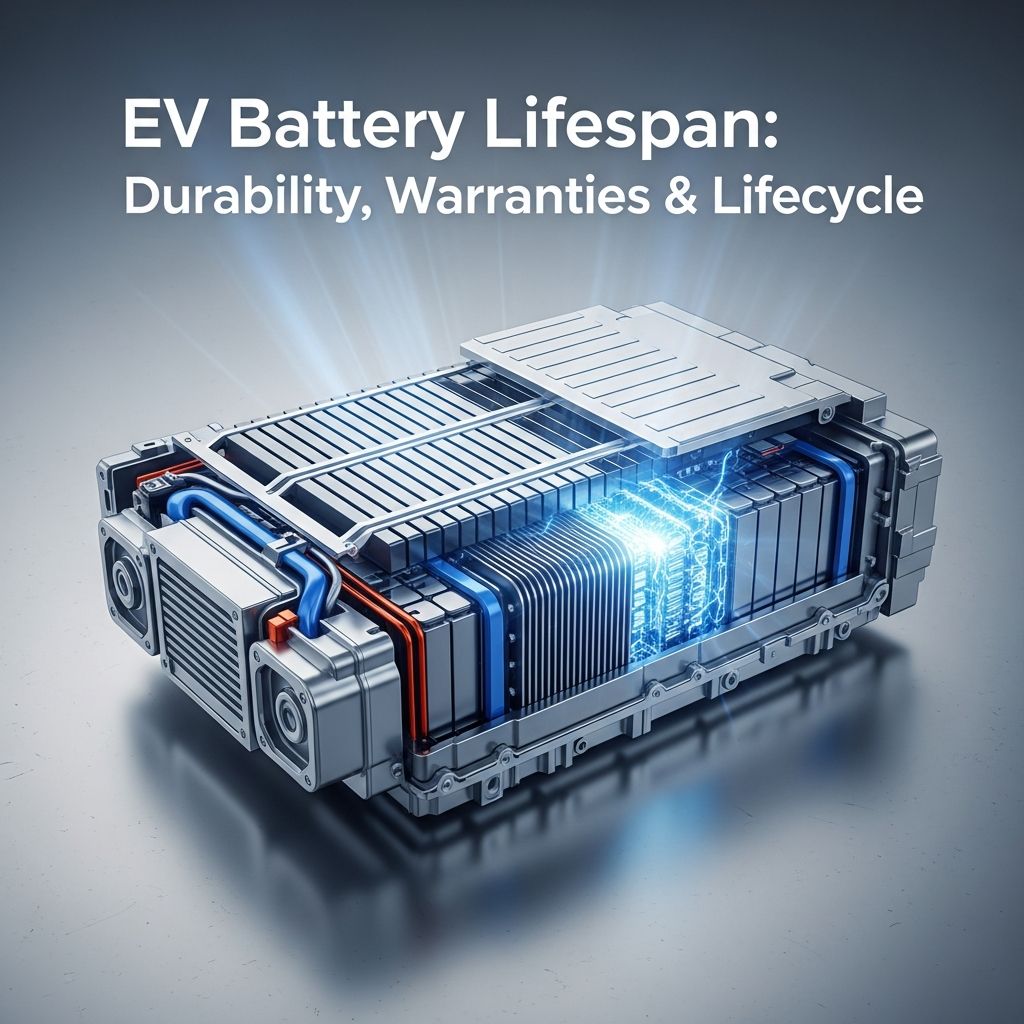
Electric Vehicle Battery Longevity: A Complete Owner’s Guide
The question of battery durability remains one of the most pressing concerns for prospective electric vehicle buyers. Understanding how long an EV battery will perform, what factors influence its lifespan, and what protections are in place through warranties provides essential context for making informed purchasing decisions. This guide explores the science behind battery longevity, real-world performance data, manufacturer protections, and the growing landscape of battery recycling and second-life applications.
Typical Battery Service Life and Degradation Patterns
Modern electric vehicle batteries are engineered to last substantially longer than many consumers expect. The typical service life of a contemporary EV battery ranges from 13 to 20 years under normal operating conditions. Analysis of over 22,700 electric vehicles across 21 different models demonstrates that modern EV batteries consistently perform well beyond their warranty periods, with an average degradation rate of approximately 2.3% annually.
Battery degradation occurs gradually through charge cycles and natural aging processes. A lithium-ion battery in an electric vehicle loses a small fraction of its total capacity with each charging and discharging cycle. However, this degradation follows a predictable curve rather than occurring in a sudden failure. Early degradation tends to be steeper, then the rate of decline slows over time. For example, real-world data from vehicle fleets shows that batteries may lose around 5-6% of their original capacity in the first 50,000 miles, but the degradation curve flattens considerably thereafter, resulting in a loss of only 10% or less after 150,000 to 200,000 miles of driving.
The relationship between distance traveled and battery capacity loss provides a useful metric for understanding battery longevity. In practical terms, if a vehicle starts with a 300-mile range, owners can expect approximately 267 miles of range after five years of typical use, reflecting the gradual degradation pattern.
Factors That Influence Battery Lifespan
Battery longevity is not uniform across all vehicles and all usage scenarios. Several environmental and operational factors significantly impact how quickly a battery degrades:
Climate and Temperature Conditions
Temperature plays one of the most critical roles in battery health. Hot climates impose a measurable penalty on battery lifespan, with vehicles operating in consistently warm conditions experiencing degradation rates approximately 0.4% faster per year compared to those in mild climates. Conversely, electric vehicles operating in moderate climate zones tend to achieve the longest service lives, typically between 12 and 15 years. Vehicles regularly used in extreme climates—whether intensely hot or cold—may see service lives reduced to 8 to 12 years.
Charging Practices and Power Levels
The manner in which an EV battery is charged significantly influences its degradation rate. High-power DC fast charging, particularly systems exceeding 100 kilowatts, emerges as the single largest stressor on battery systems. Vehicles using high-power DC fast charging exclusively experience degradation rates approximately twice as high as those relying primarily on lower-power charging infrastructure, with annual degradation rates reaching 3.0% versus 1.5% respectively. Moderate-speed Level 2 charging and strategic use of DC fast charging when necessary allow owners to preserve battery capacity more effectively.
Battery State of Charge
The state of charge—the percentage of battery capacity currently stored—influences long-term battery health. For most typical driving scenarios, owners need not worry about avoiding fully charged or nearly depleted states. However, degradation accelerates noticeably when vehicles remain at or near full charge or near-empty states for extended periods, specifically when spending more than 80% of idle time at these extreme charge levels.
Usage Intensity
Daily driving patterns and utilization intensity affect battery degradation, though this represents a manageable trade-off. While increased daily use does contribute to measurable degradation, the productivity and return on investment gains from active vehicle utilization generally justify this nominal increase in battery wear.
Manufacturer Warranty Coverage and Guarantees
Automakers have established standardized warranty frameworks to protect consumers against premature battery failure and excessive degradation:
| Manufacturer/Model | Warranty Period | Capacity Guarantee |
|---|---|---|
| Standard US Warranty | 8 years or 100,000 miles | Varies by manufacturer |
| Tesla (Most Models) | 8 years / 100,000-150,000 miles | 70% minimum capacity |
| Hyundai/Kia EVs (2020+) | 10 years / 100,000 miles | 70% minimum capacity |
| California Standard | 10 years / 150,000 miles | Manufacturer-specific |
The standard battery warranty across the United States is 8 years or 100,000 miles, whichever occurs first. However, manufacturers retain discretion over the specific capacity guarantees included within their warranty terms. Most major automakers guarantee that their EV batteries will retain at least 70% of their original capacity during the warranty period. This 70% threshold represents a practical boundary where the vehicle remains usable for most daily driving needs, though with reduced range.
California has enacted stricter requirements, mandating that automakers guarantee battery capacity for 10 years or 150,000 miles, whichever comes first. This extended protection recognizes California’s position as the nation’s leading EV market and reflects the state’s commitment to consumer protection.
Some manufacturers offer even more generous protections than the industry standard. Tesla’s warranty structure provides coverage for 100,000 to 150,000 miles depending on vehicle model and range, with the guarantee protecting not merely against complete battery failure but specifically against degradation exceeding the 70% capacity threshold. Similarly, Hyundai and Kia have implemented competitive warranty programs offering 10-year, 100,000-mile coverage with protection against capacity decline exceeding 30% over the warranty period.
The warranty framework functions as an insurance mechanism rather than a guarantee of perpetual battery performance. Once the warranty period expires, owners bear responsibility for any battery maintenance or replacement costs. However, the warranty period typically spans the time of ownership for most vehicle buyers, as average vehicle retention periods are considerably shorter than the warranty coverage provided.
Real-World Battery Performance Data
Actual performance metrics from deployed electric vehicles provide crucial validation of manufacturer specifications and warranty assumptions. Analysis of first-generation EV models, now 14 or more years old and built on earlier battery technology, shows the highest rates of battery replacements among the entire EV fleet. These early vehicles utilized less mature chemistry formulations and thermal management systems compared to contemporary models.
Modern battery technology represents a significant advancement over these early systems. Recent Stanford research suggests that contemporary EV batteries may last up to 40% longer than previously theoretical projections indicated. Combined with conservative degradation estimates of 1.8% of maximum capacity annually across the EV fleet, this implies that the average modern EV battery could potentially deliver service across 280,000 miles or more—more than double the typical internal combustion engine lifespan.
Battery capacity itself has expanded dramatically in recent years. Between 2015 and 2024, average battery sizes increased by 167%, meaning newer EV batteries can sustain greater absolute capacity losses before requiring replacement. A battery that loses the same percentage of capacity as an earlier model may still retain more usable range due to its larger overall size.
Comparative Longevity: EVs Versus Traditional Vehicles
When comparing vehicle longevity metrics, electric vehicles now match or exceed traditional internal combustion engine vehicles in overall service life. The average EV achieves a lifespan of 15 to 20 years or up to 300,000 miles, substantially exceeding the typical ICE vehicle lifespan of 12 to 15 years and approximately 133,000 to 150,000 miles.
This extended longevity reflects not only battery durability but also the reduced mechanical complexity of EV powertrains. Electric motors contain significantly fewer moving parts than traditional engines, eliminating common failure points including transmission systems, exhaust components, and complex cooling systems that typically require major repairs in conventional vehicles. Routine maintenance on EVs focuses on brake fluid, cooling systems, and tire care rather than oil changes and transmission servicing, further contributing to extended vehicle lifespans.
Battery Recycling and Second-Life Applications
As EV batteries age beyond their automotive service life, they enter a secondary economic cycle focused on recycling and repurposing. When an EV battery degrades below approximately 70-80% capacity, it becomes less suitable for automotive propulsion but retains substantial energy storage capability for stationary applications.
Second-life battery systems find applications in grid energy storage, renewable integration, and backup power systems. A battery that provides limited range for automotive use may function effectively as a home energy storage system or utility-scale battery storage facility. These applications reduce demand on the battery’s remaining capacity and operate with less demanding charge cycling patterns than automotive use.
End-of-life recycling programs recover valuable materials including lithium, cobalt, nickel, and manganese from spent battery packs. Developing battery recycling infrastructure creates economic incentives for collecting and processing end-of-life batteries, reducing the environmental burden of battery disposal and recovering critical materials needed for new battery production. Closed-loop recycling systems reduce mining requirements for battery material sourcing and create a more sustainable battery supply chain.
Maximizing Battery Longevity Through Owner Practices
While battery degradation follows predictable patterns influenced primarily by vehicle use conditions, owners can implement practices that support long-term battery health:
- Limit regular reliance on high-power DC fast charging; reserve rapid charging for occasional long-distance travel
- Maintain moderate charging practices aligned with daily driving requirements
- Avoid leaving the vehicle at full charge or empty states for extended periods
- Park vehicles in climate-controlled environments when possible to minimize temperature exposure
- Follow manufacturer recommendations for charging routines and battery maintenance
- Schedule regular software updates that may optimize battery management algorithms
Frequently Asked Questions About EV Battery Longevity
How much capacity loss is typical over the first five years?
With an average annual degradation rate of 2.3%, a typical battery experiences approximately 10-12% total capacity loss over five years, though early degradation may be slightly steeper. A vehicle with 300 miles of initial range typically shows roughly 267 miles of available range after five years.
Will my battery be covered under warranty if it degrades?
Yes, manufacturer warranties specifically protect against excessive degradation. Most warranties guarantee minimum 70% capacity retention for 8-10 years. If your battery drops below this threshold during the warranty period, manufacturers will replace it at no cost.
Is battery replacement extremely expensive?
EV batteries represent 30-50% of vehicle value when new, but most modern batteries will outlast the warranty period and typical vehicle ownership tenure. After the warranty expires, replacement costs vary substantially but have declined significantly as battery manufacturing scales.
Does fast charging permanently damage the battery?
Frequent high-power DC fast charging accelerates degradation, roughly doubling the annual degradation rate compared to Level 2 charging. However, occasional fast charging for long-distance travel causes manageable additional wear. Strategic charging practices balance convenience with battery longevity.
What happens to old batteries?
End-of-life EV batteries enter second-life applications in energy storage systems or recycling programs that recover valuable materials. This creates economic and environmental value from aged batteries rather than simple disposal.
References
- How Long Does an Electric Car Battery Last? — EV Connect. Accessed April 2026. https://www.evconnect.com/blog/how-long-does-an-electric-car-battery-last/
- Electric Car Battery Life: How Long They Last and What to Know — Car and Driver. 2023. https://www.caranddriver.com/features/a70112357/electric-car-batteries-how-long-can-they-last/
- How Long Does an Electric Car Battery Last? — Allstate. Accessed April 2026. https://www.allstate.com/resources/car-insurance/ev-batteries-last
- EV Battery Health: Key Findings from 22,700 Vehicle Data Analysis — Geotab. 2025. https://www.geotab.com/blog/ev-battery-health/
- New Data: How Long Do Electric Car Batteries Last? — Recurrent. Accessed April 2026. https://www.recurrentauto.com/research/how-long-do-ev-batteries-last
- You Won’t Believe How Long Electric Car Batteries Really Last — YouTube. Accessed April 2026. https://www.youtube.com/watch?v=ZU9bxALCyMk
- How Long Do Electric Car Batteries Last? — Ray Price Volvo. Accessed April 2026. https://www.raypricevolvocars.com/how-long-do-electric-car-batteries-last.htm





Read full bio of Sneha Tete