Eliica: Revolutionary Eight-Wheeled Electric Supercar
Discover how Japan's eight-wheeled electric marvel redefined EV performance
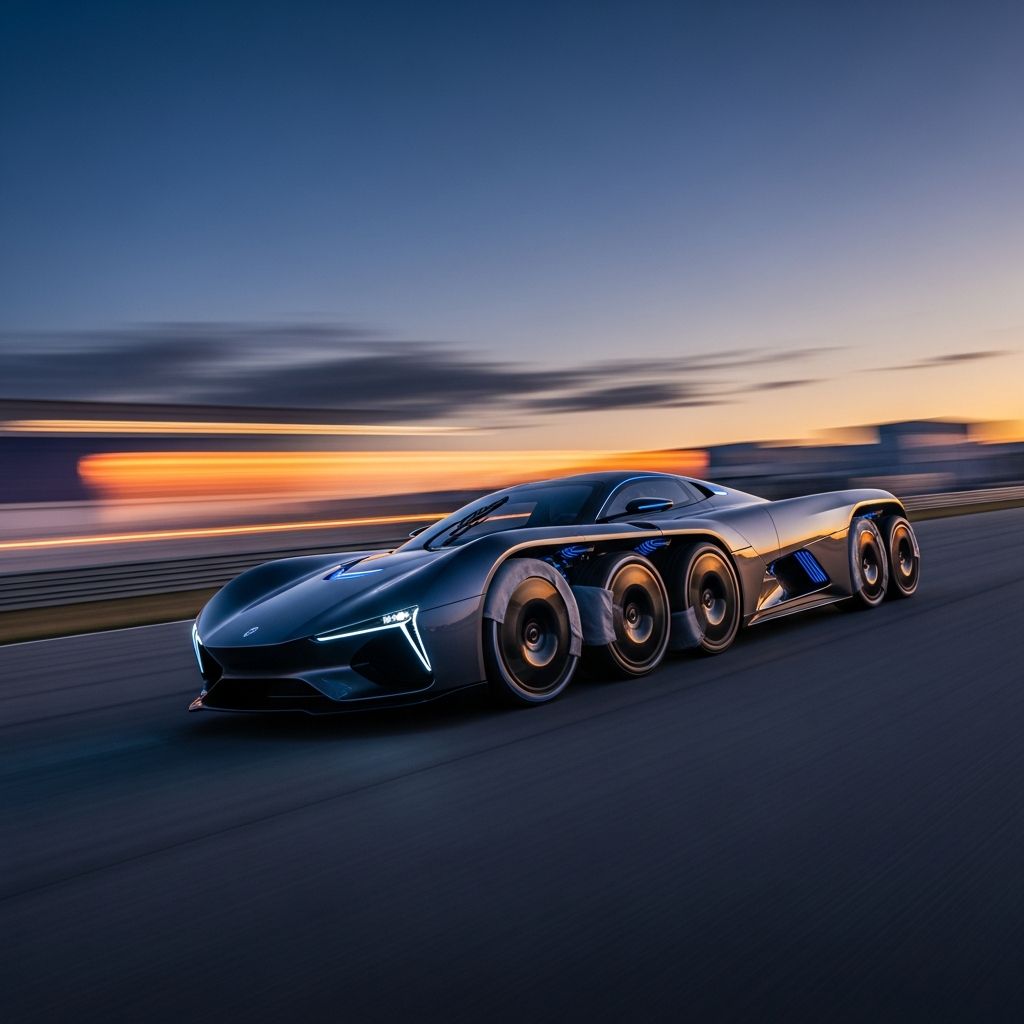
In the early 2000s, while most automotive manufacturers were still skeptical about electric vehicle capabilities, a team of researchers at Keio University in Tokyo embarked on an ambitious project that would challenge fundamental assumptions about what electric cars could achieve. The result was the Eliica (Electric Lithium-Ion Car), an eight-wheeled marvel that redefined the boundaries of electric vehicle performance and demonstrated that sustainable transportation could compete directly with gasoline-powered supercars in terms of raw speed and acceleration.
Origins and Development Vision
The Eliica was not developed in isolation. Building upon the success of the earlier KAZ (Keio Advanced Zero-Emission Vehicle), which had established an electric car speed record of 311 km/h, Professor Hiroshi Shimizu and his team at Keio University set their sights on pushing the boundaries even further. The project represented a collaborative effort involving 35 companies and numerous engineering specialists, all united by a singular vision: to create an electric vehicle that could match or exceed the performance standards set by the world’s fastest gasoline-powered production cars.
The developmental timeline placed the Eliica’s conception in the mid-2000s, with prototypes being tested and refined throughout 2004 and 2005. The team’s ultimate objective was not merely to create a fast electric vehicle, but to establish the technological foundation for a limited production run of 200 units that would position the Eliica as both the fastest electric car and the fastest production automobile globally.
Unconventional Design Architecture
The Eliica’s most immediately distinctive feature is its eight-wheel configuration, a design choice that departed radically from conventional automotive standards. While the reasoning behind this decision might appear arbitrary to casual observers, the eight-wheel arrangement served multiple critical engineering purposes that enhanced the vehicle’s overall performance characteristics.
Measuring 5.1 meters in length and weighing approximately 2,400 kilograms, the Eliica presents a futuristic silhouette that reflects its unconventional powertrain and structural engineering. Despite its substantial dimensions, the vehicle accommodates only four occupants: the driver and three passengers. The additional weight compared to traditional sports cars reflects the substantial battery pack integrated throughout the chassis.
Door Configuration and Accessibility
The Eliica incorporates an innovative door arrangement that contributes to its distinctive aesthetic. The front doors open forward in a traditional manner, while the rear doors feature an upward-opening gull-wing design, reminiscent of high-performance supercars. This configuration not only enhances the vehicle’s visual impact but also improves passenger accessibility and contributes to the overall aerodynamic profile.
Eight-Wheel Drive System and Performance Specifications
The decision to employ eight wheels fundamentally transforms the Eliica’s performance characteristics. Rather than implementing a conventional drivetrain configuration, each wheel is independently powered by its own electric motor, generating 60 kilowatts (approximately 80 horsepower) of output. This distributed propulsion system produces a combined total of 480 kilowatts, equivalent to 644 horsepower—a figure that surpasses many high-end gasoline-powered sports cars.
Acceleration and Speed Capabilities
The multi-motor configuration enables remarkable acceleration characteristics. The speed-oriented variant achieves acceleration from 0 to 100 km/h in approximately 4.1 seconds, with 0 to 160 km/h achievable in just 7 seconds. These figures place the Eliica in direct competition with some of the world’s most prestigious performance automobiles. Under controlled conditions at the Nardo test track in Italy, the Eliica demonstrated its ultimate capability by reaching a top speed of 370 km/h, establishing a new benchmark for electric vehicle performance.
The engineering team designed two distinct variants to serve different performance objectives. The speed-optimized model prioritized top-end velocity and was specifically engineered to challenge international speed records, while the acceleration-focused variant was configured for street use, featuring enhanced comfort and a reduced top speed of approximately 190 km/h, though with superior range capabilities.
Traction, Stability, and Aerodynamic Benefits
The eight-wheel architecture provides substantial advantages beyond raw power output. The additional contact points with the road surface deliver enhanced traction capabilities, enabling the vehicle to maintain stability during acceleration and high-speed maneuvers. Furthermore, the design permits the use of smaller-diameter wheels than conventional vehicles, allowing the chassis to be lowered closer to the ground. This lower center of gravity significantly improves aerodynamic efficiency and contributes to the vehicle’s impressive top-speed capabilities.
Power Management and Battery Technology
At the heart of the Eliica’s performance lies a sophisticated lithium-ion battery system that represented cutting-edge energy storage technology for the era. The battery pack comprises 80 individual lithium-ion cells organized into 20 distinct modules, strategically distributed throughout the vehicle’s integrated platform chassis. This distributed architecture ensures balanced weight distribution and optimizes the vehicle’s center of gravity.
The battery system accounts for approximately one-third of the vehicle’s total manufacturing cost, reflecting the substantial investment required for high-performance electric vehicle technology during the early 2000s. Despite this significant expense, the engineering team succeeded in creating a system capable of delivering the dramatic performance figures the vehicle demonstrated.
Charging Infrastructure and Range Specifications
Charging the Eliica requires approximately 10 hours when connected to standard household electrical outlets at 100 volts. This charging time assumes access to residential power infrastructure, making extended travel planning necessary. The energy storage capacity translates into varying operational ranges depending on the vehicle variant selected. The speed model provides approximately 200 kilometers of range, while the acceleration-oriented variant achieves extended range up to 320 kilometers on a complete charge.
These range limitations represented a significant consideration for practical ownership, particularly when compared to contemporary gasoline-powered vehicles. However, the Eliica’s primary purpose focused on demonstrating technological capability rather than establishing a practical daily-use vehicle.
Advanced Braking and Energy Recovery Systems
Each of the eight wheels incorporates disc braking systems paired with regenerative braking technology. The regenerative system captures kinetic energy during deceleration and converts this otherwise-wasted energy back into electrical storage within the battery pack. This sophisticated energy management approach extends the effective range of the vehicle and improves overall efficiency across typical driving cycles.
The distributed motor configuration enables the front wheels to handle steering independently, contributing to the vehicle’s maneuverability while the electric motors provide smooth, gear-shift-free acceleration throughout the entire performance range. The absence of traditional multi-gear transmissions eliminates the energy losses associated with conventional drivetrain systems.
Aerodynamic Engineering and Wind Tunnel Development
The Eliica’s body underwent comprehensive wind tunnel testing to optimize its aerodynamic profile for high-speed performance. The extensive development process reflected the team’s commitment to minimizing drag coefficients and reducing energy consumption at extreme velocities. Every design element, from the door configuration to the wheel sizing and suspension geometry, contributed to an integrated aerodynamic approach.
Production Plans and Market Positioning
The development team originally projected a production price of approximately $320,000 per unit in prototype configuration, with expectations that this figure would decrease during full-scale manufacturing. Despite these aspirations, the Eliica never progressed beyond the prototype phase into actual series production. The planned production run of 200 units never materialized, leaving the Eliica as a technological demonstration rather than a commercial product.
The vehicle’s positioning aimed to bridge the gap between traditional automotive categories. The design philosophy attempted to create either a four-seater sedan offering sports car performance or conversely, a sports car providing the space and ride comfort typically associated with SUVs or crossover vehicles.
Legacy and Technological Impact
Although the Eliica never achieved commercial production, its technological innovations and performance achievements profoundly influenced subsequent electric vehicle development. The eight-wheel platform, distributed motor architecture, and integrated battery system represented pioneering approaches that advanced the broader field of electric vehicle engineering. The vehicle demonstrated definitively that electric propulsion could deliver supercar-level performance when engineered with adequate investment and technological sophistication.
The Eliica’s achievement of 370 km/h established a performance benchmark that would influence electric vehicle development priorities for years to come. More importantly, the project illustrated that limitations commonly attributed to electric vehicles resulted from technological choices rather than inherent physical constraints of electric propulsion systems.
Frequently Asked Questions
- Q: Why does the Eliica have eight wheels instead of the conventional four?
- A: The eight-wheel configuration provides enhanced traction, stability, and aerodynamic advantages. Smaller wheels allow the vehicle to sit lower for improved aerodynamics and handling characteristics. Each wheel has its own 60 kW electric motor, distributing power more efficiently across all contact points with the road.
- Q: What is the Eliica’s top speed?
- A: The speed-optimized variant achieved 370 km/h (230 mph) during controlled testing at the Nardo track in Italy, while the acceleration-focused street variant was configured for a top speed of approximately 190 km/h.
- Q: How long does the Eliica take to charge?
- A: Charging from empty to full capacity requires approximately 10 hours when connected to standard 100-volt residential electrical outlets.
- Q: What is the Eliica’s range on a full charge?
- A: Range varies by variant. The speed model provides approximately 200 km, while the acceleration model achieves up to 320 km per charge.
- Q: Did the Eliica enter mass production?
- A: No. Despite original plans for 200 production units, the Eliica remained at the prototype stage and never transitioned to commercial manufacturing.
Technical Specifications Summary
| Specification | Value |
|---|---|
| Overall Length | 5.1 meters |
| Vehicle Weight | 2,400 kilograms |
| Seating Capacity | 4 passengers (driver + 3) |
| Total Power Output | 480 kilowatts (644 horsepower) |
| Motor Configuration | Eight 60 kW in-wheel motors |
| 0-100 km/h Acceleration | 4.1 seconds (speed model) |
| Maximum Speed (Speed Model) | 370 km/h |
| Maximum Speed (Acceleration Model) | 190 km/h |
| Range (Speed Model) | 200 kilometers |
| Range (Acceleration Model) | 320 kilometers |
| Charging Time | 10 hours (100V) |
| Battery Type | Lithium-ion (80 cells, 20 modules) |
| Development Timeline | Early-mid 2000s |
References
- What’s got eight wheels, does 370 km/h and doesn’t use gasoline? The Eliica! — New Atlas. November 7, 2005. https://newatlas.com/whats-got-eight-wheels-does-370-kmh-and-doesnt-use-gasoline-the-eliica/4819/
- 2005 Eliica 1st Prototype: The 8-Wheeled Electric Masterpiece — YouTube/Retro Car. https://www.youtube.com/watch?v=2rBy6JnW7NQ
- Eliica: The 8-Wheeled Speed Machine That Out-Accelerates a Porsche — YouTube. https://www.youtube.com/watch?v=IfGx8VLfB6I
- Eliica 640HP Eight-Wheeled Electric Car Review — YouTube/Pastimers. https://www.youtube.com/watch?v=oEjbHXdbTug
- Eliica Eight-Wheeled Electric Car: Heading To Production — Jalopnik. https://www.jalopnik.com/eliica-eight-wheeled-electric-car-heading-to-productio-5120911/
- KAZ eight-wheeled Eliica EV supercar — Autoblog. https://www.autoblog.com/features/kaz-eight-wheeled-eliica-ev-supercar
Similar Articles



Read full bio of Sneha Tete