E85 Fuel: Costs, Benefits and Real-World Use
Discover why E85 fuel often costs less than gasoline, its impact on vehicle performance, and when it truly saves drivers money on the road.
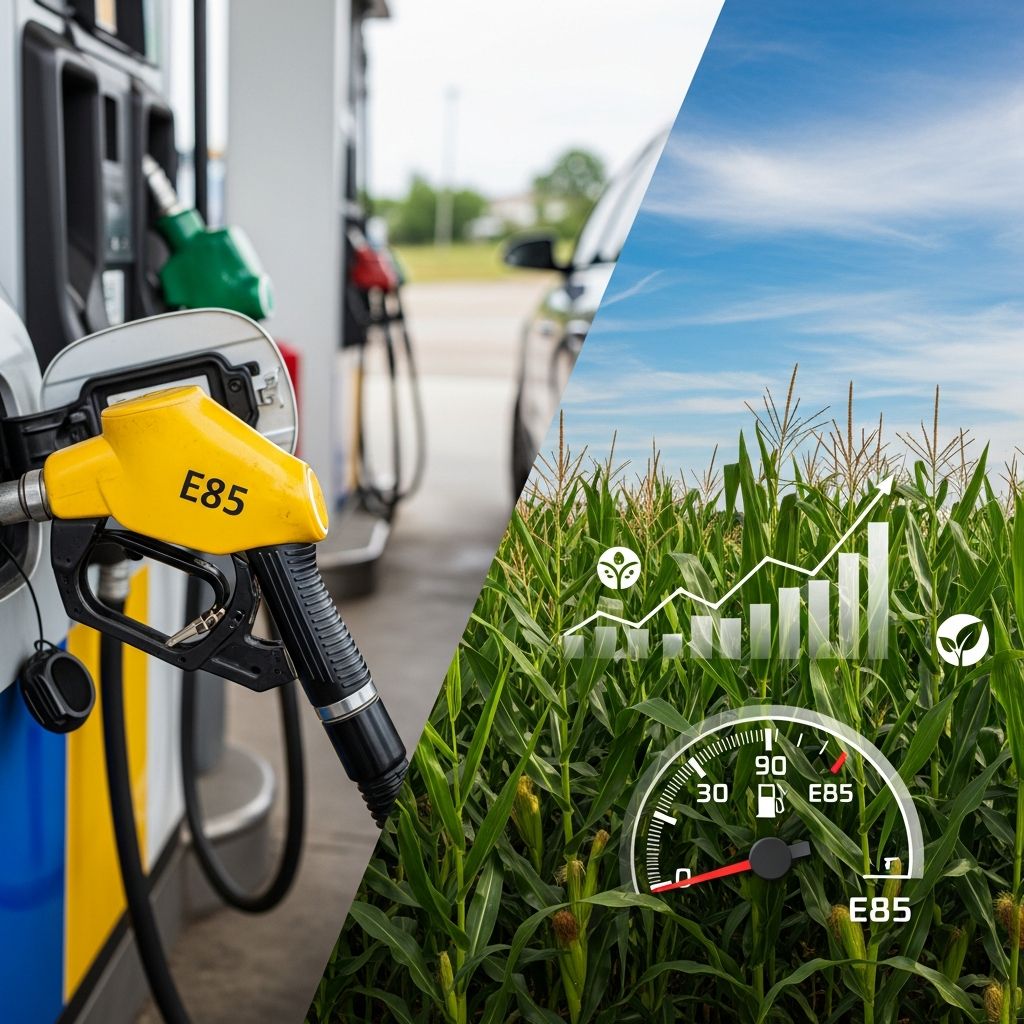
E85 fuel, a high-ethanol blend containing 51-83% ethanol mixed with gasoline, offers drivers a potentially cheaper alternative to traditional gasoline. Its lower price at the pump stems from ethanol’s production from renewable sources like corn, which benefits from agricultural subsidies and lower refining costs compared to pure gasoline. However, its reduced energy content leads to lower miles per gallon (MPG), making true savings dependent on local pricing and vehicle efficiency.
Understanding the Makeup of E85 Fuel
E85 gets its name from roughly 85% ethanol content, though actual blends vary seasonally between 51% and 83% to maintain performance in cold weather. Ethanol, a biofuel derived primarily from corn in the U.S., provides a renewable alternative to fossil fuels. This composition gives E85 a higher octane rating, often around 100-105, compared to regular gasoline’s 87-93, enabling better combustion in tuned engines.
Unlike straight gasoline, E85’s ethanol absorbs water, which can prevent fuel-line freezing in winter but requires corrosion-resistant materials in fuel systems. Flex-fuel vehicles (FFVs), designed for E85, feature specialized seals, pumps, and injectors to handle these properties safely.
Why E85 Typically Costs Less Than Gasoline
The price advantage of E85 arises from ethanol’s cheaper production. Corn-based ethanol enjoys federal subsidies and blends mandates, keeping supply high in the Midwest where most U.S. production occurs. Refining gasoline involves more complex processes like cracking and desulfurization, driving up costs. As a result, E85 often sells for 20-30% less per gallon than regular unleaded.
For instance, when gasoline reaches $4.00 per gallon, E85 might hover at $3.00 or lower, creating an apparent bargain. Blenders receive tax credits for ethanol incorporation, further reducing pump prices. Availability remains strongest in corn belt states like Iowa and Illinois, where stations offer it consistently.
Vehicle Compatibility: Who Can Run E85?
Not all cars handle E85; only FFVs with a yellow gas cap or badge indicating flex-fuel capability are approved. Manufacturers like GM, Ford, and Chrysler have produced FFVs since the 1990s, often at no extra cost. Check your owner’s manual, VIN decoder tools, or fuel doors for confirmation.
Using E85 in non-FFVs risks engine damage from corrosion or material swelling. Modern FFVs automatically detect ethanol content via sensors and adjust fuel maps, air-fuel ratios, and timing for optimal operation.
Fuel Economy Realities: MPG Drop Explained
E85 delivers about 25-30% less energy per gallon than gasoline—roughly 83,950-95,450 BTUs versus 114,000-120,000 BTUs—translating to similar MPG reductions. A vehicle achieving 25 MPG on gasoline might drop to 18-20 MPG on E85, varying by model, driving conditions, and ethanol blend strength.
This stems from ethanol’s lower combustion energy despite cleaner burning and charge-cooling effects that improve volumetric efficiency. Highway driving sees milder penalties than city stop-and-go, where ethanol’s properties shine.
Comparing Fuel Economy Side-by-Side
| Fuel Type | Energy Content (BTU/gallon) | Typical MPG (25 MPG baseline) | Range per 15-Gallon Tank |
|---|---|---|---|
| Gasoline | 114,000-120,000 | 25 | 375 miles |
| E85 | 83,950-95,450 | 18-20 | 270-300 miles |
Data adapted from energy density comparisons.
Cost Per Mile: The True Savings Metric
Pump price alone misleads; calculate cost per mile by dividing price per gallon by MPG. If gasoline costs $4.00/gallon at 25 MPG, that’s $0.16/mile. E85 at $3.00/gallon with 20 MPG equals $0.15/mile—a slight edge. Savings amplify if E85 dips below the break-even threshold.
Rule of thumb: E85 must cost 20-30% less than gasoline to match or beat economics, matching its MPG penalty. In real tests, $30 on gasoline yields 150 miles at 25 MPG, while the same on E85 provides 184-207 miles.
Break-Even Scenarios Table
| Gas Price ($/gal) | MPG Drop (%) | Break-Even E85 Price ($/gal) | Example Savings (per 10,000 miles) |
|---|---|---|---|
| $4.00 | 25% | $3.00 | $200 if E85 at $2.80 |
| $3.50 | 20% | $2.80 | $150 if E85 at $2.60 |
| $5.00 | 30% | $3.50 | $400 if E85 at $3.20 |
Calculations use formula: Break-even = Gas price × (1 – MPG drop).
Performance Boosts from E85’s High Octane
E85’s elevated octane resists knocking, allowing aggressive timing for more power. Tuned FFVs gain 10-20 horsepower and torque, with cooler intake charges from ethanol evaporation enhancing throttle response. Drag racers and enthusiasts favor it for consistent runs, though stock FFVs see milder gains.
Direct injection engines maximize these benefits, but require ECU tunes for full potential. Emissions improve too, with lower carbon monoxide and particulates.
Pros and Cons of Switching to E85
- Pros: Lower fuel costs in eligible areas; higher octane for power; renewable and domestic production reduces oil dependence; cleaner tailpipe emissions.
- Cons: Reduced MPG and range; limited station availability (fewer than 5,000 U.S. locations); potential cold-start issues; higher volumes needed per fill-up.
Regional factors matter: Midwest drivers save most, while coastal users face scarcity.
Finding E85 Stations and Planning Drives
Use apps like Alternative Fueling Station Locator from the Department of Energy to map nearby pumps. Midwest dominates with over 80% of stations, but urban growth aids access. Stock up on gasoline for long trips due to shorter E85 range.
Environmental and Long-Term Vehicle Impacts
E85 cuts greenhouse gases by 20-40% over gasoline lifecycle, per corn-to-wheel analyses, though farming inputs like fertilizer offset some gains. Engines experience less carbon buildup from ethanol’s oxygen content. Long-term, FFVs show no accelerated wear when maintained properly.
FAQ: Common E85 Questions Answered
Can any car use E85?
No, only certified FFVs. Verify via yellow cap or VIN check.
Does E85 void my warranty?
No, using E85 in approved vehicles maintains coverage.
Is E85 always cheaper overall?
Not always; depends on local prices exceeding the 20-25% discount threshold.
How much MPG do I lose on E85?
Typically 15-30%, averaging 25%.
Is E85 better for the environment?
Yes, lower lifecycle emissions than gasoline, though not zero-impact.
Is E85 Right for Your Driving Needs?
For high-mileage commuters in E85-rich areas with FFVs, it delivers tangible savings—up to $1,200 yearly on 20,000 miles. Enthusiasts value performance perks. Casual drivers may prefer gasoline’s ubiquity. Track local prices and test personally for best results.
References
- E85 vs. Gasoline – Economy & Consumption — eFlexFuel. Accessed 2026. https://eflexfuel.com/us/e85-vs-gas-economy-consumption
- E85 Vs Gasoline (Performance Cost MPG And Horsepower) — Elan Fuels. Accessed 2026. https://www.elanfuels.com/e85-vs-gasoline-regular-fuel-premium-ethanol-benefits-burn-diesel-flex-vehicle/
- E85 vs Gasoline: Fuel Economy, Cost Per Mile & Real Savings — E85 Gas Finder. Accessed 2026. https://e85gasfinder.com/blog/e85-vs-gasoline-cost-fuel-economy/
- E85 vs. Gasoline Comparison Test — Edmunds. Accessed 2026. https://www.edmunds.com/fuel-economy/e85-vs-gasoline-comparison-test.html
- The pros and cons of using E85 over regular gas — WXYZ. Accessed 2026. https://www.wxyz.com/news/the-pros-and-cons-of-using-e85-over-regular-gas-and-how-to-check-if-you-car-can-use-it
- E85 (Flex Fuel) — Alternative Fuels Data Center, U.S. Department of Energy. Accessed 2026. https://afdc.energy.gov/fuels/ethanol-e85
Similar Articles








Read full bio of medha deb