Compact Crossover Showdown: C4, CX-30, and XCeed
Comparing three popular compact crossovers across performance, efficiency, and practicality
Evaluating Three Leading Compact Crossovers: A Comprehensive Buyer’s Guide
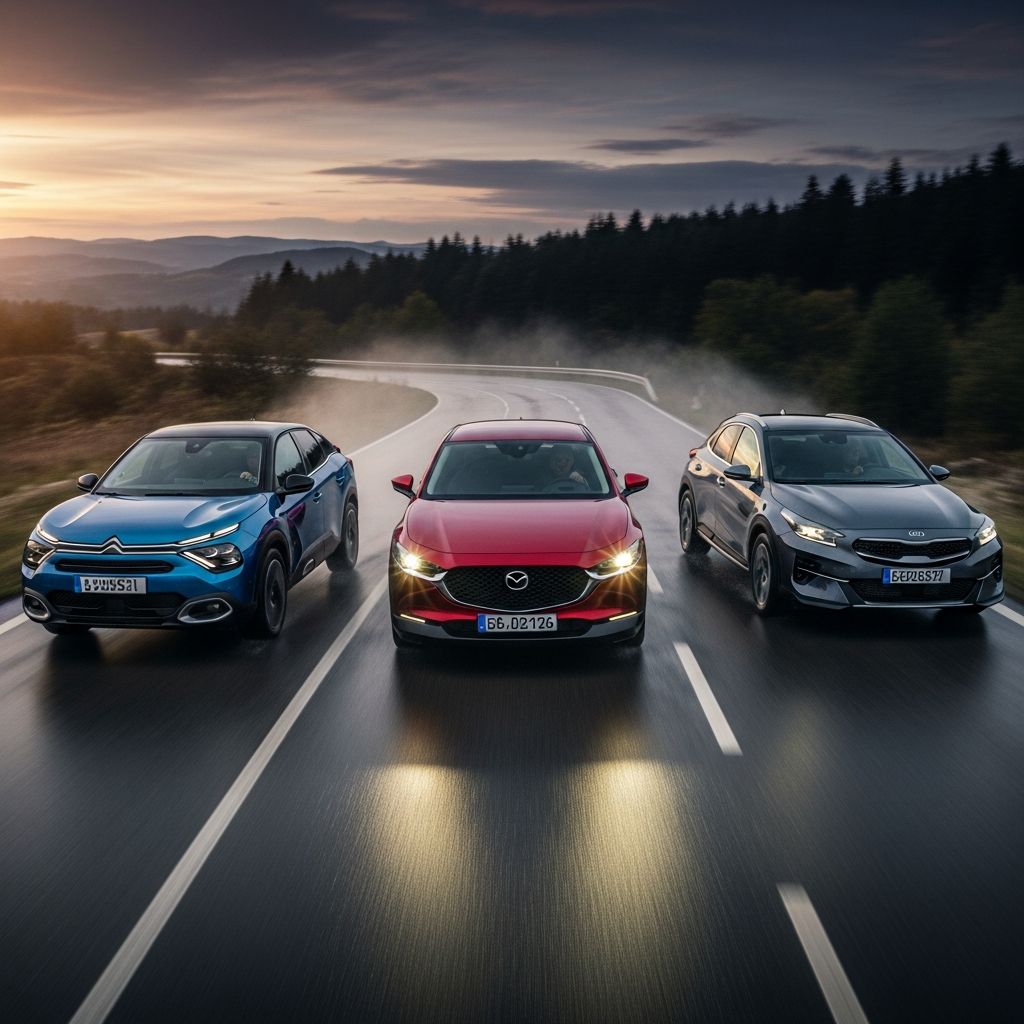
The compact crossover segment has emerged as one of the most competitive automotive categories, blending the practicality of traditional hatchbacks with the elevated driving position and commanding aesthetics of sport utility vehicles. Three vehicles have established themselves as frontrunners in this space: the Citroën C4, Mazda CX-30, and Kia XCeed. Each model presents a distinct philosophy regarding design, performance, and value proposition, making the decision between them a nuanced choice that depends heavily on individual priorities and driving preferences.
This comprehensive examination explores the technical specifications, real-world performance metrics, financial implications, and practical considerations that distinguish these three competitors. Whether you prioritize fuel efficiency, dynamic handling, interior accommodation, or long-term ownership costs, understanding how these vehicles compare across multiple dimensions will inform a more confident purchasing decision.
Market Positioning and Design Philosophy
The three vehicles occupy an interesting middle ground in the automotive marketplace. Rather than being conventional hatchbacks with modest ground clearance adjustments, each model represents a deliberate engineering approach to creating vehicles with genuine SUV-like characteristics without the inherent drawbacks of increased weight and elevated center of gravity.
The Kia XCeed builds upon the proven platform architecture of the standard Kia Ceed hatchback, introducing a lengthened and widened body structure combined with enhanced wheel arch styling to project a more substantial presence. This approach delivers increased visual presence while maintaining the dynamic handling characteristics developed for the hatchback.
The Mazda CX-30 similarly leverages the engineering foundation of the Mazda 3 compact car, introducing more aggressive ground clearance and sportier body panels to achieve its crossover identity. This design philosophy prioritizes maintaining the engaging driving dynamics the Mazda 3 is renowned for while adding the psychological benefits of increased seating height and commanding visibility.
The Citroën C4 represents a more substantial departure from traditional French compact car conventions, presenting a design that emphasizes interior space and comfort alongside modern styling elements. The C4 positions itself as an accessible entry point into the crossover segment, with competitive pricing that broadens appeal to budget-conscious buyers.
Engine Performance and Acceleration Characteristics
Engine displacement and power output represent the most immediately comparable performance metrics across these three vehicles. The differences in specifications translate into distinct driving experiences that merit careful consideration.
| Vehicle Model | Engine Configuration | Power Output (bhp) | Acceleration (0-62 mph) | Top Speed |
|---|---|---|---|---|
| Citroën C4 PureTech 130 | 1.2L 3-cylinder turbo | 128 | 8.9 seconds | 130 mph |
| Kia XCeed 1.5 T-GDi | 1.5L 4-cylinder turbo | 158 | 8.7 seconds | 129 mph |
| Mazda CX-30 2.0 e-Skyactiv-X | 2.0L 4-cylinder | 183 | 8.3 seconds | 127 mph |
The Citroën’s 1.2-litre three-cylinder turbocharged engine produces 128 horsepower, positioning it as the least powerful option in the trio. However, this apparent disadvantage masks an important nuance regarding perceived performance. Despite the lower numerical output, the C4’s engine delivers particularly responsive torque characteristics from low engine speeds, creating a subjective impression of greater power availability than the specifications suggest. The acceleration from 0-62 mph of 8.9 seconds remains competitive, trailing the XCeed’s 8.7-second time by only 0.2 seconds.
The Kia XCeed leverages turbocharging technology in its 1.5-litre four-cylinder engine to generate 158 horsepower. The strategic placement of the turbocharger in this 1,500cc displacement yields 253 Nm of peak torque available from just 1,500 rpm, providing strong mid-range acceleration characteristics that many drivers find particularly useful for daily driving scenarios. This torque-oriented tuning philosophy differentiates the XCeed’s driving character from its competitors.
The Mazda CX-30 employs a naturally aspirated 2.0-litre four-cylinder engine producing 183 horsepower, the highest among the three options. Rather than pursuing forced induction, Mazda’s engineering emphasizes the development of high-revving, efficient combustion characteristics through their e-Skyactiv-X technology. The quickest 0-62 mph time of 8.3 seconds reflects this power advantage, though the difference from the C4 represents only 0.6 seconds in real-world acceleration.
Fuel Economy and Operational Running Costs
Fuel efficiency emerges as a significant financial consideration across the three-to-five-year typical ownership period, with the differences in consumption patterns translating into substantial cumulative cost variations.
During professional testing, the Mazda CX-30 achieved 41.9 miles per gallon, establishing itself as the efficiency leader among the three vehicles. This superior consumption reflects the benefits of the e-Skyactiv-X engine technology and Mazda’s broader engineering commitment to optimizing thermal efficiency. Over the course of a year assuming average driving patterns, this translates into financial savings of approximately £150-200 compared to the Citroën.
The Citroën C4 recorded 37.4 miles per gallon during testing, performing marginally better than the Kia despite its smaller engine displacement. The 1.2-litre turbo’s efficiency advantage over the XCeed likely reflects lower absolute fuel consumption volumes rather than superior thermal efficiency. Annual fuel costs for the C4 average approximately £1,823 based on tested consumption figures.
The Kia XCeed demonstrated 36.4 miles per gallon, the lowest consumption efficiency of the trio. The higher fuel costs reflect the performance-oriented tuning of the 1.5-litre turbo engine, which prioritizes responsive acceleration over maximum efficiency. The annual fuel cost differential compared to the Mazda exceeds £200, representing a meaningful factor in total cost of ownership calculations.
Carbon dioxide emissions paint a similar narrative, with the C4 producing 120 g/km, the XCeed 142 g/km, and the CX-30 127 g/km respectively. All three vehicles fall within the lower tax brackets for company car considerations, though the C4’s advantages are noteworthy for those evaluating vehicles for business purposes.
Interior Accommodation and Practical Usability
The spatial characteristics of a vehicle profoundly influence the ownership experience, affecting comfort for occupants and the vehicle’s versatility for cargo and lifestyle requirements.
The Kia XCeed claims the position as the most spacious of the three options in terms of rear passenger accommodation. The relatively upright roofline and generous window apertures combine to create an airy cabin atmosphere that adult passengers find particularly comfortable. The 10.25-inch touchscreen infotainment system comes equipped as standard, incorporating smartphone integration capabilities through both Android Auto and Apple CarPlay platforms.
The Citroën C4 ranks second in rear-seat spaciousness, offering considerably more legroom than the Mazda despite its more compact exterior proportions. The emphasis on interior volume over exterior styling represents a deliberate design trade-off that prioritizes passenger comfort. The C4’s approach appeals particularly to those who prioritize practicality and daily usability over design ostentation.
The Mazda CX-30 presents a more constrained rear passenger environment, with the sloping roofline characteristic of crossover styling reducing effective headroom for taller occupants. While legroom remains adequate for average-height passengers, the combination of these spatial limitations makes the CX-30 the least accommodating option for families with adult rear-seat passengers or frequent use of rear seating positions.
Regarding cargo capacity, the Mazda and Kia provide nearly identical configurations at approximately 430 and 426 litres respectively with rear seats upright. The Citroën C4 provides 380 litres in standard configuration. However, when considering extended cargo requirements with rear seats folded, the Mazda expands to 1,406 litres while the XCeed offers 1,378 litres and the C4 reaches 1,250 litres. These extended capacities prove particularly valuable for individuals who periodically transport larger items such as luggage or sporting equipment.
Driving Dynamics and Handling Characteristics
The subjective experience of operating these vehicles varies considerably, reflecting distinct engineering philosophies regarding suspension tuning, steering feedback, and overall chassis dynamics.
The Mazda CX-30 demonstrates the most refined handling characteristics, with suspension geometry that maintains composure during spirited cornering while absorbing road imperfections with admirable poise. The precise steering feedback and well-balanced weight distribution create a driving experience that resembles the engaging dynamics of the Mazda 3 from which it derives. Enthusiastic drivers appreciate the CX-30’s willingness to be driven with purposeful intent while maintaining a composed demeanor.
The Kia XCeed presents capable handling with a firmer suspension setup that transmits road feedback directly to the driver. The higher torque availability from the turbocharged engine translates into more forceful acceleration characteristics compared to naturally aspirated alternatives. The combination of responsive steering and predictable body control creates a vehicle that encourages confident driving, though the suspension tuning occasionally produces a slightly abrupt ride quality over poorly maintained road surfaces.
The Citroën C4 prioritizes ride comfort over dynamic engagement, with a suspension setup tuned to absorb imperfections and create a serene cabin atmosphere. The steering exhibits a notably numb character compared to competitors, lacking the precision feedback that some driving enthusiasts prefer. However, for drivers prioritizing relaxed, comfortable cruising over dynamic cornering, the C4’s approach proves entirely appropriate and even preferable.
Financial Considerations and Long-Term Value
The total cost of vehicle ownership extends considerably beyond the purchase price, encompassing depreciation, running costs, maintenance, and taxation implications across the ownership period.
| Metric | Citroën C4 | Kia XCeed | Mazda CX-30 |
|---|---|---|---|
| Purchase Price | £23,005 | £24,550 | £26,300 |
| 3-Year Residual Value | £11,549 (50.2%) | £9,650 (39.3%) | £13,992 (53.2%) |
| Total Depreciation (3 years) | £11,456 | £14,902 | £12,308 |
| Annual Road Tax | £150 | £150 | £150 |
The Citroën C4 offers the lowest purchase price at £23,005, creating an attractive entry point for budget-conscious buyers. The relatively strong residual value retention at 50.2% after three years means the actual cost of depreciation remains moderate at £11,456 over the ownership period.
The Kia XCeed presents a mid-range purchase price of £24,550 but demonstrates weaker residual value retention at 39.3%, resulting in the highest absolute depreciation figures among the three at £14,902 over three years. This characteristic may concern buyers prioritizing long-term value retention and total ownership economics.
The Mazda CX-30 commands the highest purchase price at £26,300 but compensates through exceptional residual value retention at 53.2% after three years. This strong value retention reduces the effective cost of ownership for those planning to retain the vehicle or eventually resell it. Buyers viewing the vehicle as a three-year proposition may find the Mazda’s superior residual performance partially offsets its higher initial investment.
Safety Equipment and Warranty Considerations
Modern vehicle safety encompasses both active accident prevention systems and passive structural protection, with all three competitors providing commendable provision in these areas.
The Kia XCeed benefits from the Ceed platform’s five-star Euro NCAP safety rating and includes automatic emergency braking, lane-keeping assistance, parking sensors, and a reversing camera as standard equipment. The exceptionally generous seven-year/100,000-mile warranty provides psychological reassurance regarding long-term reliability and mechanical integrity.
Both the Citroën and Mazda provide six airbags and rear parking sensors as standard. The Mazda offers additional convenience through front and rear parking sensors, while both provide reversing cameras. However, Mazda’s more conservative three-year/60,000-mile warranty represents a shorter coverage period than the Kia’s offering.
Towing Capacity and Utility
For buyers who occasionally require towing capability for trailers or caravans, the specified capacities merit consideration. The Mazda CX-30 supports towing up to 1,300 kilograms, establishing itself as the most capable option. The Citroën C4 follows at 1,200 kilograms, while the Kia XCeed provides 1,000 kilograms of towing capacity. These specifications influence the vehicle’s suitability for those contemplating recreational activities involving boat or caravan towing.
Fuel Tank Capacity and Range Considerations
The Mazda and Kia both provide 51 and 50-litre fuel tank capacities respectively, while the C4 matches the Kia at 50 litres. These specifications combine with fuel consumption characteristics to determine driving range between refueling occasions. The Mazda’s superior efficiency combined with adequate fuel tank volume yields the greatest range, approaching 470 miles between fill-ups under tested conditions.
References
- Citroen C4 vs Mazda CX-30 vs Kia XCeed — Auto Express. 2021. https://www.autoexpress.co.uk/car-group-tests/354843/citroen-c4-vs-mazda-cx-30-vs-kia-xceed
- Kia XCeed vs Mazda CX-30 Comparison — Willow Leasing. https://www.willowleasing.com/news/kia-xceed-vs-mazda-cx-30/
- Citroen C4 vs Mazda CX-30 Comparison — DriveDuel UK. https://uk.driveduel.de/compare/citroen/c4/vs/mazda/cx-30
Similar Articles


Read full bio of Sneha Tete