Skoda Citigo-E IV Vs VW E-Up! City EV Comparison
Discover how Skoda's Citigo-e iV stacks up against Volkswagen's e-up! in range, performance, charging, and everyday usability for urban drivers.
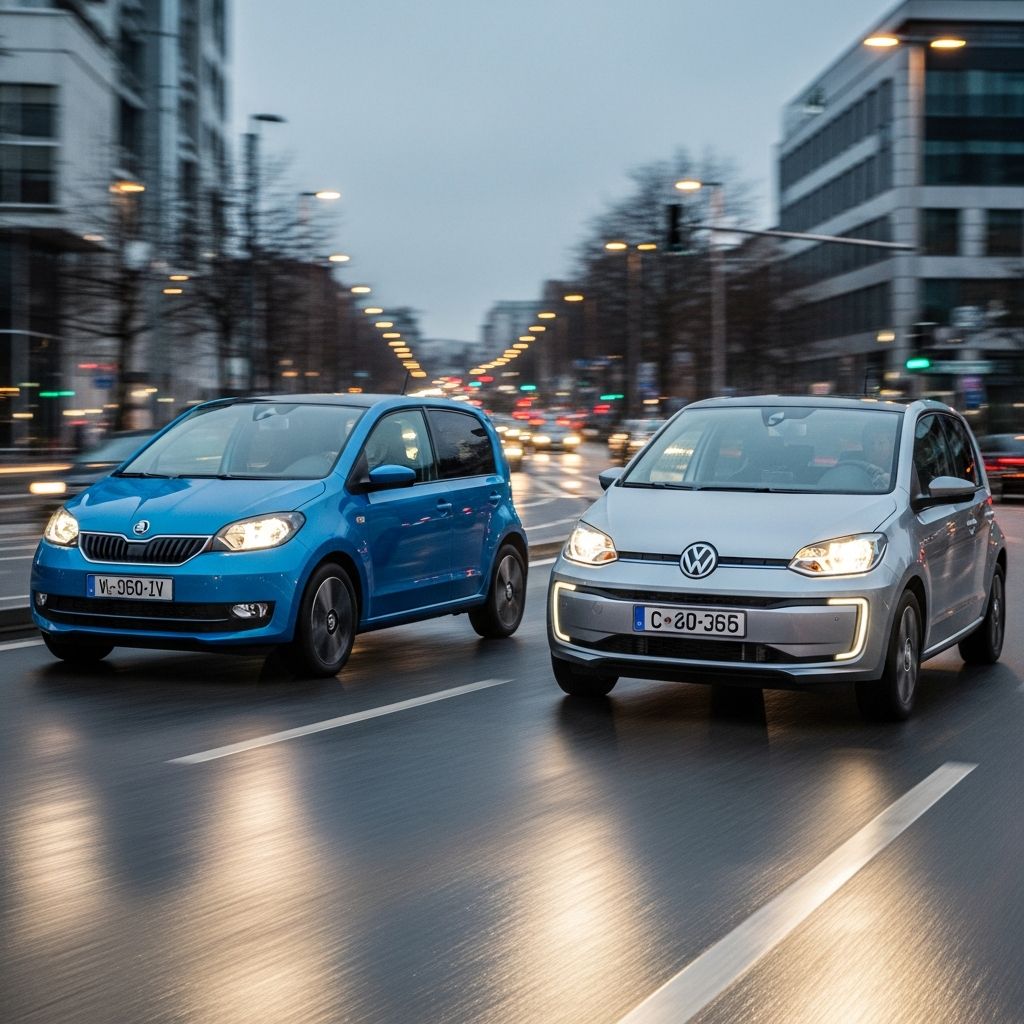
Citigo-e iV vs e-up!: Electric City Car Duel
Compact electric vehicles like the Skoda Citigo-e iV and Volkswagen e-up! represent an accessible entry into zero-emission driving, particularly for city dwellers. Both models, produced on the same Slovakian assembly line, share identical powertrains and batteries but differ subtly in refinement and market positioning. This analysis draws from technical specifications and performance data to highlight their strengths and nuances.
Background and Production Overview
Launched as part of the Volkswagen Group’s push into electrification, the Citigo-e iV arrived in 2019 and ran until 2021, while the e-up! spanned 2020 to 2023 with a larger 36.8 kWh battery option. Both are front-wheel-drive hatchbacks designed for European markets, now discontinued but available affordably on the used market. Their shared DNA ensures similar core capabilities, yet branding influences perceived quality and features.
Skoda positions the Citigo-e iV as a practical, value-driven option with thoughtful interior touches, whereas Volkswagen markets the e-up! with a premium feel through updated infotainment and materials. Production in Slovakia underscores their cost efficiency, making them lighter and more agile than larger EVs.
Powertrain and Battery Technology
At the heart of both cars lies a permanent magnet synchronous motor (PMSM) delivering 61 kW (82 hp) and around 212 Nm of torque. Acceleration from 0-100 km/h takes 12.3 seconds for the Citigo-e iV and 11.9 seconds for the e-up! 36.8 kWh variant, with top speeds capped at 130 km/h. These figures suit urban commuting perfectly, offering instant torque for quick merges.
The 36.8 kWh nominal battery (32.3 kWh usable) is standard in later models, enabling WLTP ranges of 257 km for Citigo-e iV and 260 km for e-up!. Real-world efficiency hovers at 14.8 kWh/100 km and 14.4 kWh/100 km respectively, translating to about 6.75-6.93 km/kWh. Earlier e-up! models used an 18.7 kWh pack with shorter 133 km WLTP range, highlighting the upgrade’s impact.
| Specification | Skoda Citigo-e iV | VW e-up! 36.8 kWh |
|---|---|---|
| Battery Capacity (Nominal) | 36.8 kWh | 36.8 kWh |
| Usable Capacity | 32.3 kWh | 32.3 kWh |
| WLTP Range | 257 km | 260 km |
| Efficiency (kWh/100 km) | 14.8 | 14.4 |
| 0-100 km/h | 12.3 s | 11.9 s |
This table summarizes key powertrain metrics, showing the e-up!’s marginal edge in acceleration and efficiency.
Charging Capabilities Compared
Charging infrastructure compatibility is identical: both support 7.2 kW AC and 40 kW DC via CCS Type 2 ports on a 400V architecture. Full AC charges from a domestic wallbox take about 5.5 hours, while DC rapid charging reaches 80% in under an hour. No significant differences here, making them versatile for home, work, or public stations.
- AC Max: 7.2 kW (0-100% in ~5h30m)
- DC Max: 40 kW (10-80% in ~48m)
- Standard 2.3 kW: ~16h45m full charge
Owners report reliable charging, though real-world times vary with temperature and battery state.
Dimensions, Weight, and Practicality
Measuring around 3.6 meters long, 1.645 meters wide, and 1.48-1.49 meters tall, these city cars excel in tight parking spaces. Wheelbases near 2.42 meters provide stable handling without sacrificing maneuverability. Curb weights of 1235 kg keep them nimble.
Interior space accommodates four passengers, with 250 liters of boot capacity expanding to 923 liters folded. No frunk or towing capacity limits long-haul utility, but urban shoppers appreciate the versatility.
| Dimension | Skoda Citigo-e iV | VW e-up! 36.8 kWh |
|---|---|---|
| Length | 3597 mm | 3600 mm |
| Width (w/o mirrors) | 1645 mm | 1645 mm |
| Height | 1481 mm | 1492 mm |
| Wheelbase | 2422 mm | 2417 mm |
| Boot (seats up/max) | 250/923 L | 250/923 L |
Dimensions are nearly identical, ensuring comparable practicality.
Driving Experience and Handling
In city environments, both deliver peppy performance with low noise and smooth one-pedal driving. The e-up! feels slightly sharper in acceleration (11.5 s 0-60 mph vs 11.8 s), benefiting from minor tuning. Suspension handles potholes adequately for their size, though firmer setups prioritize agility over comfort.
Regenerative braking is adjustable, extending range in stop-go traffic. Real-world tests show 120-mile ranges at 3.7 mi/kWh, aligning with WLTP claims under moderate conditions.
Safety Features and Reliability Ratings
Standard safety includes ABS, stability control, and multiple airbags. Euro NCAP ratings from shared platforms indicate solid protection, though specific EV scores vary. Reliability-wise, Skoda edged Volkswagen in 2020 surveys (5th vs 19th), praising build quality and low running costs.
Both benefit from group-wide EV expertise, with minimal issues reported beyond occasional software glitches. Zero road tax and low BIK (16%) appeal to company car users.
Ownership Costs and Market Value
Used prices hover around €10,000-11,000 for 36.8 kWh models, undercutting larger EVs. Home charging costs pennies per mile, with warranties covering batteries for 8 years/160,000 km. Maintenance mirrors petrol siblings due to simple drivetrains.
- Used Price (Europe): €10,990 (Citigo) vs €10,999 (e-up!)
- Road Tax: £0
- CO2: 0 g/km
Interior Quality and Technology
Skoda’s cabin features practical ‘Simply Clever’ storage, while VW offers a more polished dashboard with larger screens in later e-up! trims. Infotainment supports Apple CarPlay/Android Auto, with DAB radio standard. Ride comfort is even, though rear space suits adults for short trips only.
Environmental Impact and Efficiency Scores
With efficiencies of 23.2-23.9 kWh/100 miles, they outperform many contemporaries. GCC scores rate e-up! at 4.5 vs Citigo’s 4.4, factoring range, charging, and performance. Lifecycle emissions remain low, especially with renewable charging.
Pros and Cons Summary
| Aspect | Skoda Citigo-e iV Pros | VW e-up! Pros |
|---|---|---|
| Range/Efficiency | Solid WLTP figures | Slightly better real-world |
| Performance | Quick urban torque | Faster 0-60 |
| Practicality | Ample storage | Identical boot space |
| Reliability | Top survey ranking | Premium build feel |
Which One Wins for Urban Drivers?
The Volkswagen e-up! narrowly leads with superior efficiency and acceleration, ideal for efficiency-focused buyers. Skoda Citigo-e iV counters with better reliability perceptions and value. Both excel as budget EVs for daily commutes under 100 miles.
Frequently Asked Questions
What’s the real-world range of these cars?
Expect 200-220 km in mixed driving, dropping in winter.
Can they handle highways?
Top speed suits motorways, but range limits long trips.
Are batteries warrantied?
Yes, typically 8 years/160,000 km to 70% capacity.
How do they compare to newer city EVs?
Cheaper used, but shorter range than modern rivals like Renault Zoe.
Charging at home: what do I need?
7 kW wallbox recommended for overnight full charges.
References
- Škoda Citigo-e iV vs Volkswagen e-Up! 36.8 kWh Comparison — Green Cars Compare. 2023. https://greencarscompare.com/compare/cars/skoda-citigo-iv-vs-vw-e-up-2020/
- Skoda Citigo-e iV vs Volkswagen e-up! — Auto Express. 2020-10-29. https://www.autoexpress.co.uk/skoda/citigo/351930/skoda-citigo-e-iv-vs-volkswagen-e
- Škoda Citigo-e iV vs Volkswagen e-Up! Variants Comparison — Green Cars Compare. 2023. https://greencarscompare.com/global/compare/cars/skoda-citigo-iv-vs-vw-e-up-2013-vs-vw-e-up-2020/
- 2019 Volkswagen e-up! vs 2020 ŠKODA CITIGOe iV Comparison — EV Specifications. N/A. https://www.evspecifications.com/en/comparison/52c67a0
- EV City Car Test Video — YouTube (RSEV). 2020. https://www.youtube.com/watch?v=pLSFtYvcDOw
- Skoda Citigo-e iV vs Volkswagen e-up!: Safety and Reliability — Driving Electric. 2023. https://www.drivingelectric.com/reviews/1777/skoda-citigo-e-iv-vs-volkswagen-e-safety-and-reliability
Similar Articles




Read full bio of medha deb