Body-on-Frame vs Unibody: Key Differences
Discover how body-on-frame and unibody constructions compare in strength, efficiency, off-road prowess, and everyday driving to choose the right vehicle type.
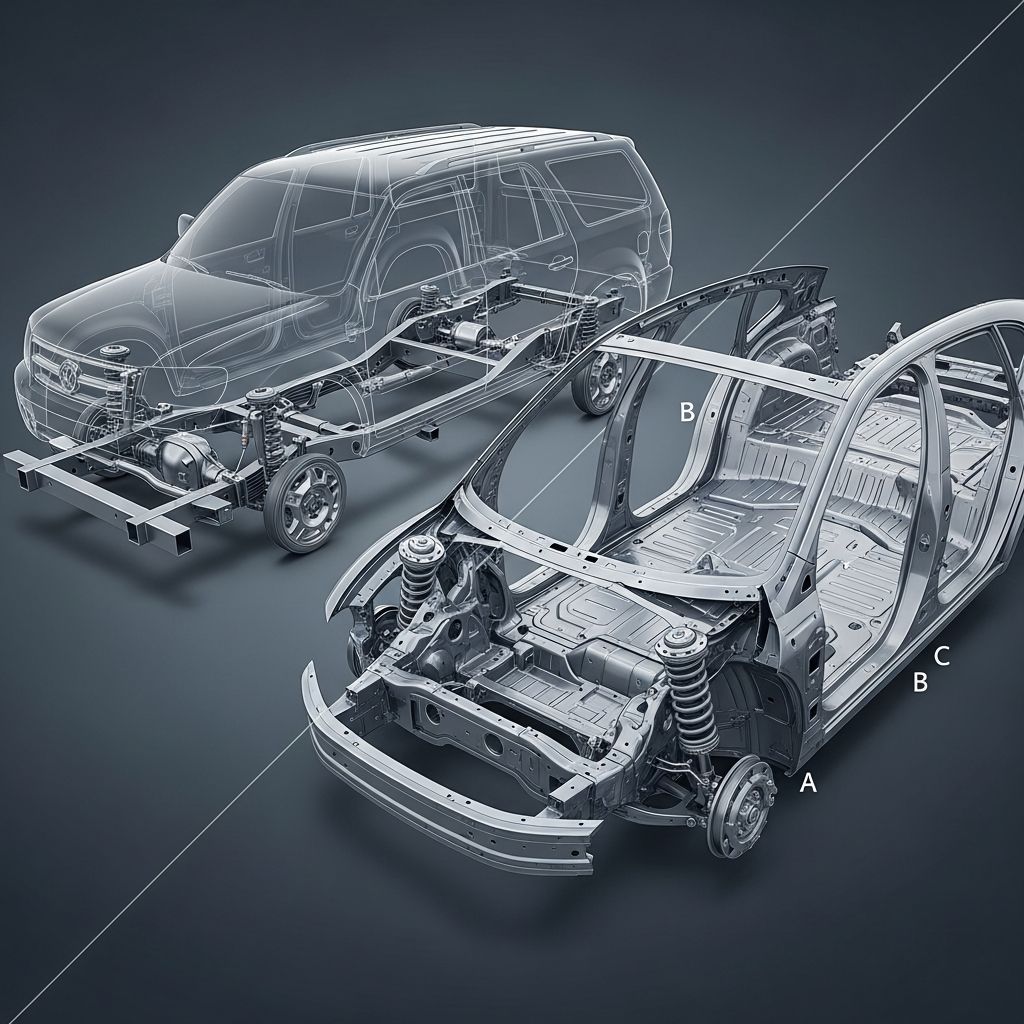
Vehicle construction fundamentally shapes performance, durability, and suitability for tasks like off-roading or daily commuting. Body-on-frame designs feature a separate steel ladder frame supporting the body, ideal for heavy-duty applications, while unibody integrates the body and frame into one rigid structure for lighter, more efficient rides.
Understanding Body-on-Frame Construction
This traditional approach uses a robust ladder-like steel frame as the vehicle’s backbone. The body, including cabin and cargo areas, bolts onto this frame via rubber isolators, which reduce vibrations transmitted to passengers. Common in trucks and large SUVs, this setup excels in rugged environments because the frame absorbs stresses from loads or terrain independently of the body.
- Modular Design: The same frame supports multiple body styles, from pickups to vans, simplifying manufacturing.
- Durability Focus: Steel construction withstands twisting forces during off-road articulation without compromising the passenger compartment.
- Historical Roots: Originating from early trucks, it remains prevalent for its proven resilience under extreme conditions.
Decoding Unibody Construction
Unibody merges the body panels, floor, roof, and structural elements into a single welded unit, creating a monocoque shell. This method, standard in sedans, crossovers, and many modern SUVs, distributes forces across the entire vehicle for enhanced rigidity.
- Integrated Strength: Pillars, rocker panels, and crumple zones work together to manage crash energies effectively.
- Weight Savings: Eliminating a separate frame reduces overall mass, boosting fuel economy and acceleration.
- Modern Prevalence: Adopted widely since the 1980s for passenger vehicles due to superior on-road dynamics.
Structural Comparisons at a Glance
| Aspect | Body-on-Frame | Unibody |
|---|---|---|
| Weight | Heavier due to added frame | Lighter overall construction |
| Fuel Efficiency | Lower MPG from extra mass | Higher efficiency, better economy |
| Towing Capacity | Up to 9,000+ lbs typically | Limited, often under 3,500 lbs |
| Off-Road Capability | High; frame handles flex | Moderate; less tolerant of abuse |
| Handling | Solid but truck-like | Sharper, car-like response |
This table highlights core trade-offs, with body-on-frame prioritizing capability over refinement, and unibody favoring efficiency and agility.
Performance in Off-Road Scenarios
For trail enthusiasts, body-on-frame shines. The separate frame allows wheel articulation without stressing the body, preventing cracks or misalignment on rocky paths. Vehicles like heavy-duty trucks maintain integrity during high-stress maneuvers, such as climbing boulders or crossing ruts. Rubber bushings further isolate the cabin from chassis flex, though this can introduce some road noise.
Unibody vehicles, while capable in mild off-road with features like all-wheel drive, falter under prolonged abuse. The integrated structure transmits impacts directly, risking panel damage or frame warping. They’re better suited for gravel roads or light trails rather than extreme rock crawling.
Towing and Hauling Capabilities
Body-on-frame dominates heavy-duty tasks. The rigid frame distributes trailer weight evenly, supporting massive capacities without sagging. This design’s strength prevents frame twisting under tongue loads exceeding thousands of pounds. It’s why full-size pickups lead commercial and recreational towing.
Unibody limits stem from load-bearing body stress. Maximums hover lower, suitable for small campers or boats, but not semi-trailers. Exceeding ratings risks structural fatigue over time.
On-Road Driving Dynamics and Comfort
Unibody vehicles deliver sedan-like handling with a lower center of gravity, reducing body roll in corners and enhancing stability at highway speeds. The stiff shell minimizes flex for precise steering feedback and a composed ride.
Body-on-frame trucks feel planted for straight-line duties but exhibit more lean and vagueness due to higher mass and softer suspensions tuned for loads. Cabin isolation via bushings quiets NVH better in some cases, though overall refinement lags.
Safety and Crash Performance
Unibody’s engineered crumple zones and rigid passenger cells excel in collisions, absorbing energy progressively. Lower profiles reduce rollover risks, and integration simplifies advanced features like stability control.
Body-on-frame offers robust protection via frame energy absorption but higher centers increase tip-over potential. Modern reinforcements mitigate this, yet unibodies generally score higher in side-impact tests.
Repair and Maintenance Considerations
Body-on-frame repairs target specific areas: frame straightening for collisions or body panel swaps without structural overhaul. This modularity cuts costs for rust or wreck damage.
Unibody fixes demand full-section replacements if compromised, escalating expenses. However, lighter weight reduces wear on components like brakes and tires.
Fuel Economy and Environmental Factors
Unibody’s reduced curb weight translates to 20-30% better MPG in comparable models, aiding compliance with emissions standards. Hybrids and EVs leverage this for extended range.
Body-on-frame’s heft demands powerful engines, guzzling more fuel, though diesel options improve torque efficiency for towing.
Real-World Vehicle Examples
- Body-on-Frame: Full-size pickups like Ford F-150 or Chevrolet Silverado; rugged SUVs such as Toyota 4Runner.
- Unibody: Crossovers like Toyota RAV4 or Honda CR-V; sedans and most passenger cars.
Choices reflect use cases: trucks for work, unibodies for family transport.
Which Construction Wins for You?
Neither is universally superior; selection hinges on needs. Prioritize towing or off-roading? Opt for body-on-frame. Seeking efficiency, handling, and safety? Unibody prevails. Hybrids like some mid-size trucks blend traits, but pure forms retain distinct edges.
Frequently Asked Questions (FAQs)
What is the main advantage of body-on-frame over unibody?
Superior durability for towing, hauling, and off-roading due to the separate robust frame.
Are unibody vehicles safer?
Yes, generally, thanks to integrated crumple zones and lower rollover risk from reduced height.
Can unibody trucks handle heavy towing?
Limited compared to body-on-frame; best under 3,500 lbs to avoid stress.
Which is more fuel-efficient?
Unibody, owing to lighter weight and aerodynamic integration.
Is body-on-frame cheaper to repair?
Often yes, as damage isolates to body or frame without affecting the whole structure.
References
- Engineering Explained: Unibody vs Body On Frame – Which Is Best? — YouTube (Engineering Explained). Accessed 2026. https://www.youtube.com/watch?v=IhbXPzPlzNI
- Unibody vs. Body-on-Frame: Pros, Cons, and Best Uses — YouTube. Accessed 2026. https://www.youtube.com/watch?v=MEUvpbv3ezM
- Unibody Vs. Body-on-Frame: What’s the Difference? — RealTruck. Accessed 2026. https://realtruck.com/blog/unibody-vs-body-on-frame-whats-the-difference/
- Unibody vs Body On Frame vehicles: What you should know — Toyota of Orlando. Accessed 2026. https://www.toyotaoforlando.com/research/unibody-vs-body-on-frame-vehicles-what-you-should-know.html
- Unibody vs Body-on-Frame: What’s the Difference? — Autolist. Accessed 2026. https://www.autolist.com/guides/body-on-frame-vs-unibody
Similar Articles








Read full bio of Sneha Tete