BMW M: Evolution of Performance
Discover over 50 years of BMW M's racing heritage, iconic models, current powerhouses, and electrified future innovations.
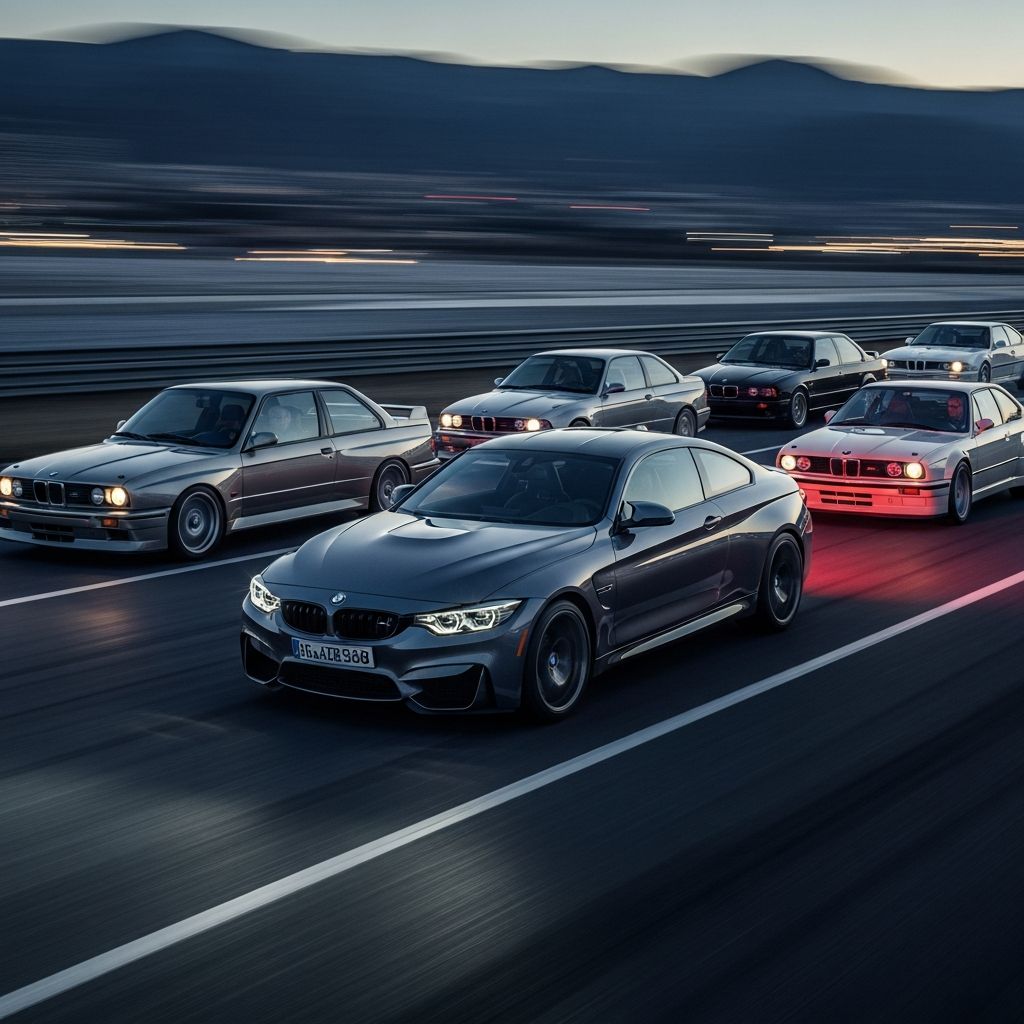
BMW M represents the pinnacle of automotive engineering, transforming racing technology into road-legal machines for over five decades. Born from motorsport ambitions, this division has delivered vehicles that balance raw power, precision handling, and everyday usability.
Origins in Motorsport Excellence
The story of BMW M begins in 1972 with the establishment of BMW Motorsport GmbH, a dedicated subsidiary focused on racing success. This initiative stemmed from a board decision to centralize high-performance development, leading to early triumphs like the 3.0 CSL’s victory at the Nürburgring 24 Hours in 1973. The ‘Batmobile’ nickname for the 3.0 CSL highlighted its aggressive aerodynamic features, setting the tone for future M models.
Renamed BMW M GmbH in 1993, the division evolved from pure racing to producing street cars infused with track DNA. Early efforts emphasized lightweight construction and potent engines, laying the foundation for a lineup that would dominate touring car championships throughout the 1970s.
Iconic Milestones: The Birth of Legendary Models
The BMW M1, launched in 1978 as the E26, marked the first production car to wear the M badge. This mid-engine supercar, produced until 1981 with just 450 units, featured a tubular spaceframe and a 3.5-liter straight-six engine delivering around 273 horsepower. Its rarity and design, even celebrated by artist Andy Warhol, cemented its status as a collector’s icon.
Following the M1, the 1980s brought sedan and coupe expansions. The E28 M5 from 1986-1988 introduced the super-sedan concept with a 3.5-liter inline-six pushing 256 horsepower, blending luxury with blistering acceleration. Simultaneously, the E24 M635CSi coupe offered grand touring prowess with a turbocharged inline-six. The game-changer arrived in 1986 with the E30 M3, engineered for Group A racing. Requiring 5,000 road units for homologation, it featured a 2.3-liter four-cylinder engine evolving to over 400 horsepower in race trim, securing multiple touring car titles and becoming the most successful model in its class.
- M1 (1978-1981): Mid-engine pioneer, 450 units, iconic design.
- E28 M5 (1986): First super-sedan, inline-six power.
- E30 M3 (1986): Racing legend, homologation special.
Expansion into Diverse Body Styles
BMW M’s portfolio grew beyond coupes and sedans. The 1990s and 2000s saw M badges on wagons and SUVs, broadening appeal. The E39 M5 wagon offered practicality with 394 horsepower from a V8, while the E46 M3 refined the compact sports sedan formula with a high-revving straight-six.
SUVs entered the fray with the E53 X5 M in the early 2000s, followed by the F85 X5 M and X6 M. These high-riding performers packed twin-turbo V8s exceeding 500 horsepower, proving M engineering could conquer family haulers without sacrificing dynamics. The smaller G01 X3 M Competition and G02 X4 M Competition, launched in 2019, delivered 503 horsepower in compact packages, attracting performance enthusiasts seeking versatility.
| Model | Years | Key Engine | Power Output |
|---|---|---|---|
| X5 M (F85) | 2011-2018 | Twin-turbo V8 | 567 hp |
| X3 M Competition (G01) | 2019-present | Twin-turbo inline-six | 503 hp |
| X4 M Competition (G02) | 2019-present | Twin-turbo inline-six | 503 hp |
Current Lineup: Power and Precision Today
Today’s BMW M roster spans sedans, coupes, and SUVs, each embodying ‘Motorsport’ ethos. The F87 M2, introduced in 2016 and updated since, serves as the entry-level thrill machine with a 453-horsepower twin-turbo straight-six, rear-wheel drive, and bulging fenders reminiscent of past icons.
The F90 M5, a benchmark super-sedan, unleashes 600 horsepower and 553 lb-ft from a 4.4-liter twin-turbo V8 under 24.5 psi of boost, achieving 0-60 mph in under 3.5 seconds. At the top, the F92 M8 Competition gran coupe and convertible offer 617 horsepower in a luxurious package, blending opulence with track capability.
M Performance variants like the M340i provide accessible M flavor without full M intensity, featuring tuned engines and chassis upgrades on core BMW models.
Engineering Philosophy: Track to Street
BMW M’s core tenets include adaptive M suspension, carbon-ceramic brakes on flagships, and active M differential for cornering mastery. Carbon fiber reinforced plastic (CFRP) lightens structures, as seen in the M Performance Parts catalog offering aerodynamic kits and forged wheels.
Engines prioritize linear power delivery; straight-six and V8 units rev freely, often exceeding 7,000 rpm, paired with eight-speed automatics featuring lightning-fast shifts.
Embracing Electrification: The M Future
As BMW pivots to electrification, M leads with hybrids and pure EVs. The XM, a bold plug-in hybrid super-SUV, combines a V8 with electric motors for over 650 horsepower, marking M’s first standalone model since the M1.
Upcoming models promise quad-motor setups for all-wheel-drive EVs, delivering instant torque and all-wheel steering for agility. Concepts preview fully electric M3 successors and i4 M60 variants, maintaining handling purity through low battery placement and advanced chassis tech. Engineers emphasize meeting fan expectations, with high internal standards for the first full EV M car.
By 2030, expect a fully electric M lineup alongside hybrids, preserving the driving event that defines M ownership.
Performance Heritage in Numbers
- 50+ Years: From 1972 founding to present.
- M3 Success: Most victorious touring car ever.
- Production Milestones: Over 100,000 M3 units across generations.
- Racing Wins: Multiple ETCC titles, F1 support in 1983.
Why BMW M Endures
BMW M thrives by evolving: from analog racers to digital hybrids, always prioritizing driver engagement. Track days at Nürburgring underscore ongoing development, with M cars lapping faster each generation.
Frequently Asked Questions
What does BMW M stand for?
M stands for Motorsport, originating from the 1972 BMW Motorsport GmbH racing division.
What’s the most iconic BMW M car?
The E30 M3 is widely regarded as the most influential due to its racing dominance and road appeal.
Are there electric BMW M cars?
Yes, starting with the hybrid XM and expanding to full EVs with quad motors planned.
How does BMW M differ from M Sport?
Full M models feature unique engines and chassis; M Sport adds styling and suspension on standard cars.
What’s next for BMW M?
Electrified performance with maintained dynamics, including electric sedans and SUVs.
References
- BMW M: Past, Present, And Future — Top Speed. 2023. https://www.topspeed.com/bmw-m-past-present-and-future/
- What is BMW M? Past, present and future of the Bavarian powerhouse — Auto Express. 2025-04-12. https://www.autoexpress.co.uk/bmw/366514/what-bmw-m-past-present-and-future-bavarian-powerhouse
- BMW M Overview – History, Technology, and FAQs — BMW USA. 2026. https://www.bmwusa.com/vehicles/bmw-m/overview.html
- The History of BMW M Cars — Stratstone. 2023. https://www.stratstone.com/blog/m-power-timeline-of-bmw-m-cars/
- M Past and Future — BMW YouTube. 2023. https://www.youtube.com/playlist?list=PLuXwAhsNhc_EB140dYt_nnsNynWLk-aSS
- The BMW M Story. 40 Years BMW M GmbH — BMW Group PressClub. 2012. https://www.press.bmwgroup.com/usa/article/detail/T0126930EN_US/the-bmw-m-story-40-years-bmw-m-gmbh?language=en_US
Similar Articles


Read full bio of Sneha Tete