Audi RS4 Avant Engine Guide
Discover the power, efficiency, and evolution of the Audi RS4 Avant's twin-turbo V6 engine that redefines performance wagons.
Audi RS4 Avant Engine Guide: Power and Precision Redefined
The Audi RS4 Avant stands as a pinnacle of performance engineering in the estate car segment, blending blistering acceleration with everyday usability. At its heart lies a sophisticated 2.9-litre twin-turbocharged V6 engine that produces 450 PS (444 bhp) between 5,700 and 6,700 rpm, paired with 600 Nm of torque available from just 1,900 to 5,000 rpm. This powertrain, shared with high-performance models like the Audi RS5 and Porsche variants, propels the RS4 Avant from 0-62 mph in 4.1 seconds while maintaining refined composure.
Engine Architecture and Technology
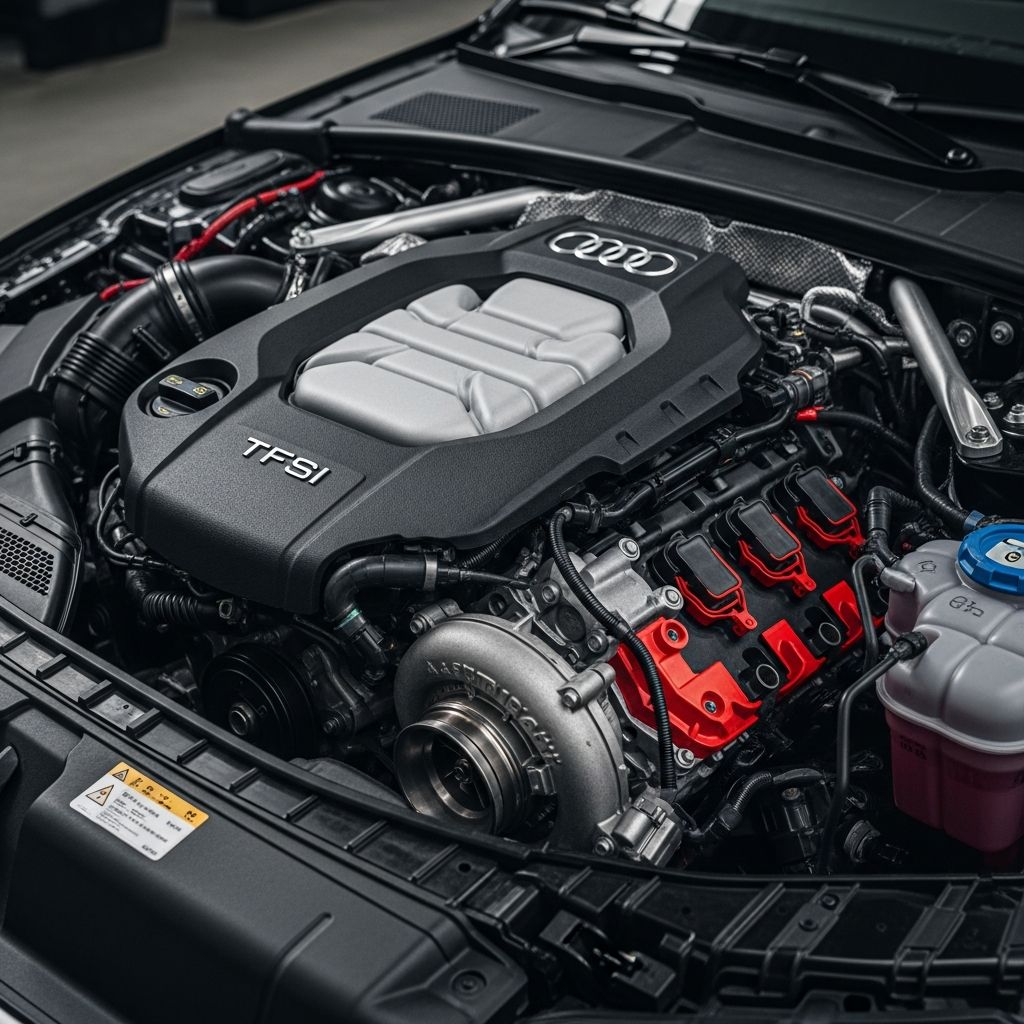
The RS4 Avant’s power unit is a 2.9-litre (2,894 cc) V6 with direct injection, 24 valves, and dual overhead camshafts (DOHC). Twin turbochargers enable specific output of 155 PS per litre, a testament to Audi’s efficient forced-induction expertise. This EA839 engine family member is 35 kg lighter than the previous 4.2-litre V8 it replaced, improving front-end balance and reducing understeer in dynamic driving.
Key technologies include variable valve timing, high-pressure fuel injection up to 350 bar, and advanced cooling systems that support revs up to 6,700 rpm. The biturbo setup minimises lag, delivering seamless power from low revs, while intercoolers ensure dense air charge for sustained performance.
- Displacement: 2.9 litres for optimal torque density
- Configuration: 90-degree V6 with turbochargers nestled in the valley
- Compression Ratio: Around 10:1, balancing efficiency and boost
- Materials: Aluminium block and heads for weight savings
Transmission and Drivetrain Integration
Power flows through an 8-speed Tiptronic automatic transmission, a shift from earlier dual-clutch units for smoother high-torque handling. This ZF-sourced gearbox offers rapid shifts and paddle-shift control, with launch control for repeatable 0-60 times. Paired with Audi’s quattro all-wheel drive featuring a sport differential, it distributes torque rearward up to 85% under load, enhancing cornering agility.
The front-engine, all-wheel-drive layout weighs 1,715-1,914 kg kerb, yielding 249 PS per tonne power-to-weight. Torque vectoring via the rear differential sharpens turn-in, making the wagon handle like a sports sedan.
Performance Metrics and Acceleration
Expect 0-60 mph in under 4.1 seconds, with quarter-mile times around 12 seconds. Top speed is electronically limited to 155 mph, extendable to 174 mph via optional packages. Real-world tests confirm 441-465 PS on dyno, with torque peaking at 600-632 Nm.
| Metric | Value | Notes |
|---|---|---|
| 0-62 mph | 4.1 seconds | Official Audi figure |
| Top Speed | 155 mph (limited) | Up to 174 mph optional |
| Power-to-Weight | 249 PS/tonne | Impressive for estate |
| Torque-to-Weight | 332 Nm/tonne | Low-end punch |
Fuel Efficiency and Emissions
Despite its potency, the RS4 Avant achieves 9.5 L/100 km combined (31 mpg UK), better than V8 predecessors thanks to downsizing and stop-start tech. CO2 emissions range 189-311 g/km, with a 58-litre tank offering around 611 km range. Real-world figures vary with driving style, but efficiency modes in Audi drive select optimise cruising.
Premium unleaded (PULP) fuel is required, supporting the high compression and boost levels.
Evolution from Past Generations
Earlier RS4 models relied on naturally aspirated V8s: the B7 (2006) had a 4.2L unit with 420 hp at 7,800 rpm and 430 Nm, revving to 8,250 rpm. The B8 (2012) matched 450 PS but with less torque. The B9 generation’s V6 matches power while boosting torque by 170 Nm from smaller displacement, improving efficiency and response.
This shift mirrors industry trends towards turbocharged downsizing, shared with Porsche Panamera 4S, enhancing low-end usability without V8 thirst.
Driving Dynamics Enhanced by Engine
The lighter V6 repositions mass, fostering neutral handling. Quattro with sport differential actively manages rear torque split, countering oversteer or understeer. Audi drive select modes—Comfort, Auto, Dynamic, RS—alter throttle mapping, suspension, and steering for versatile use.
On track, the engine’s broad torque band sustains momentum, while the 8-speed holds gears optimally. Daily drives benefit from refined NVH levels and adaptive dampers.
Model Year Updates and Pricing
Recent years show pricing evolution: 2026 models start at $165,015 AUD, with consistent 2.9L/8-speed specs. Fuel consumption holds at 9.5 L/100 km across 2022-2026. In Europe, base prices range €79,333-€125,550.
| Year | Price From (AUD) | Fuel Use (L/100km) |
|---|---|---|
| 2026 | $165,015 | 9.5 |
| 2025 | $165,015 | 9.5 |
| 2024 | $139,700 | 9.5 |
| 2023 | $123,530 | 9.5 |
| 2022 | $112,090 | 9.5 |
Reliability and Maintenance Considerations
Audi’s V6 benefits from shared Porsche development, with robust internals for track abuse. Turbo maintenance involves premium oil changes every 10,000 km. Carbon buildup on valves is mitigated by direct injection design. Owners report strong longevity with regular servicing.
- Service Interval: 12 months/15,000 km
- Oil Capacity: ~8.4 litres
- Common Checks: Turbo intercoolers, high-pressure fuel pump
Competitive Edge in Performance Estates
Against rivals like BMW M3 Touring or Mercedes-AMG E63 S, the RS4 Avant excels in practicality with 495-1,490 litres boot space, without compromising speed. Its V6 torque curve outperforms some inline-six competitors in mid-range pull.
Frequently Asked Questions (FAQs)
What fuel does the Audi RS4 Avant require?
Premium unleaded (PULP or 98 RON), essential for optimal performance and engine health.
Is the RS4 Avant faster than its sedan counterpart?
Identical powertrain yields matching 0-62 mph of 4.1 seconds; wagon’s extra weight is offset by tuning.
How does the new V6 compare to the old V8?
Matches power, adds 170 Nm torque, sheds 35 kg, improves efficiency.
What’s the real-world fuel economy?
Around 9.5 L/100 km combined, dropping to 12-15 L/100 km in spirited driving.
Can the top speed be increased?
Yes, optional packs raise it to 174 mph with stability systems active.
Why Choose the RS4 Avant’s Engine?
This powertrain encapsulates Audi’s philosophy: supercar pace in a family hauler. Its blend of tech, torque, and traction sets benchmarks for super-wagons, appealing to enthusiasts valuing versatility.
References
- Audi RS4 Avant B9 specs, 0-60, quarter mile, lap times — FastestLaps.com. 2017 (updated). https://fastestlaps.com/models/audi-rs4-avant-b9
- Audi RS4 Engine – Specs & Motor Options — CarsGuide. 2024 (updated). https://www.carsguide.com.au/audi/rs4/engine
- Audi RS 4 Avant | RS Range — Audi UK Official Site. 2024 (updated). https://www.audi.co.uk/en/models/a4/rs-4-avant/
- Audi RS 4 – Wikipedia — Wikipedia (sourced from official docs). 2024 (updated). https://en.wikipedia.org/wiki/Audi_RS_4
- Audi RS4 Avant (B9) 2.9 TFSI (450 Hp) quattro tiptronic — Auto-Data.net. 2017 (updated). https://www.auto-data.net/en/audi-rs4-avant-b9-2.9-tfsi-450hp-quattro-tiptronic-32087
- Audi RS4 Performance, Engines, Top Speed & 0-62 — Auto Express. 2018 (updated). https://www.autoexpress.co.uk/audi/rs4/103006/avant/engines
Similar Articles



Read full bio of medha deb